

Summary:
IPO is the key growth driver of VC in China (7x more exit proceeds than M&A).
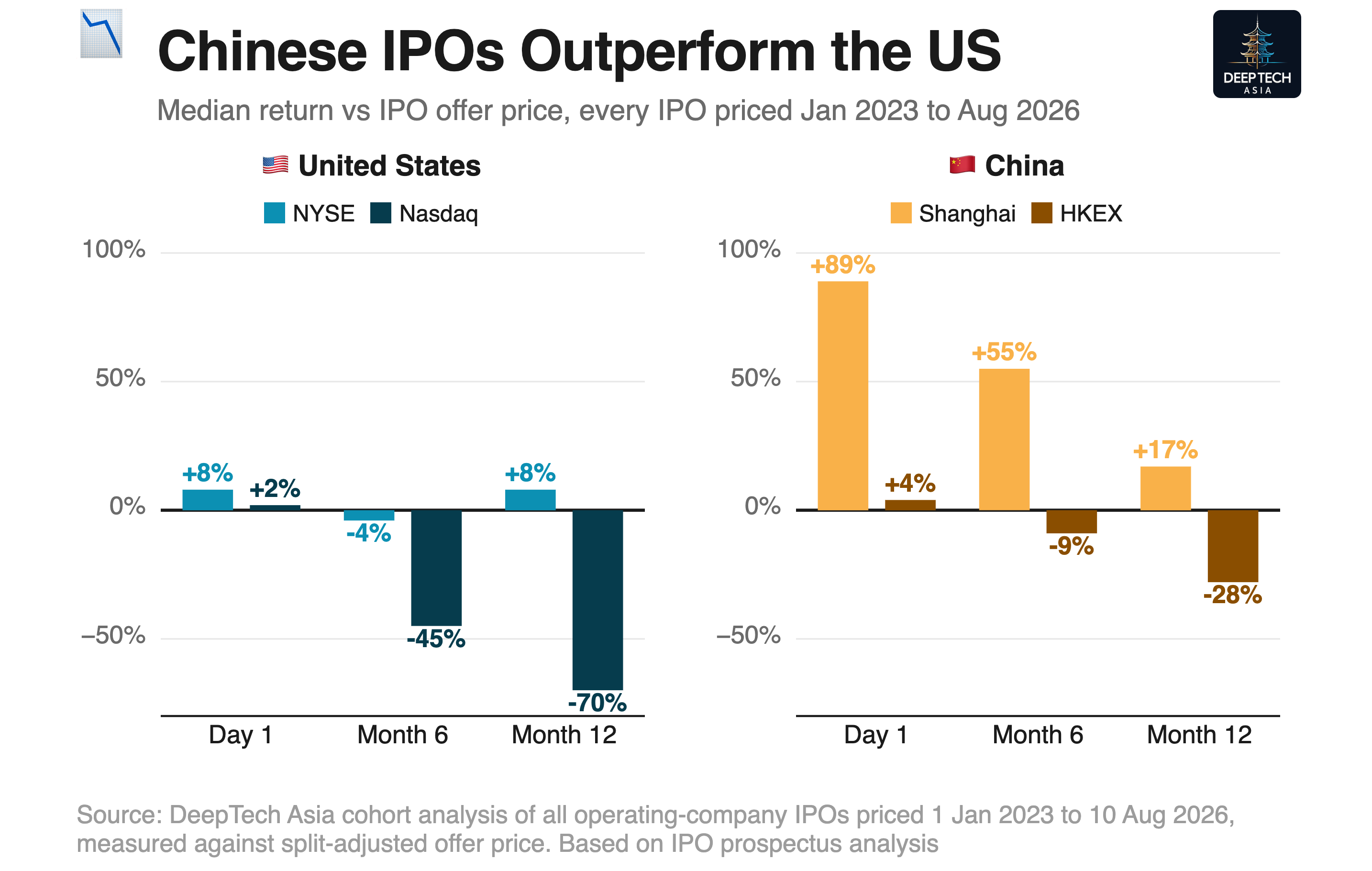
China’s IPO scale is comparable to the US, but with consistently higher returns — both on day-1 trading and after the lock-ups expire (6 and 12 months after IPO).
Shanghai IPOs have demonstrated some of the world’s highest median returns for the past three years: 89% on day-1 trading and +17% in 12 months after IPO.
Key question — how long will it last?
China’s IPO market is going through a bifurcation:
Mainland exchanges (A-shares) are evolving into “premium” IPO platforms, offering strong returns but with stricter IPO requirements, hence supporting fewer listings.
Hong Kong is emerging as the “mass-market” IPO destination — the default exit route for Chinese unicorns, although returns are below those in Mainland markets.
While A-share IPOs are expected to keep growing at a moderate and “managed” pace, the health of the Hong Kong IPO market is crucial for China’s VC sector overall.
So far, there are positive signs pointing that the HK IPO trend will continue:
IPO count and trading volumes are almost doubling every year,
Post-lockup 12 month IPO returns are improving: -4% now vs -42% in 2024,
Retail IPO oversubscription surged to over 500x compared to 10-30x before 2024.
But there are several risks:
Weak investor demand is still the most substantial one — IPO returns (proxy for demand) is not growing as fast as IPO count (supply); if IPO underperformance persists, investors might get discouraged and choose alternative platforms.
Government crackdown of a similar scale as in 2020-2021 is less likely, but some industry-specific scrutiny measures are possible.
Geopolitical escalation is unpredictable, it can have a detrimental effect on overseas investor demand, but is unlikely to cripple the HK IPO market alone.
You as investors cannot avoid risks, but you can minimise them — see the final section of the article with practical ideas on how to do it.
Email me at denis@deeptech.asia to receive the full IPO datasets used in this analysis.
IPO is the primary VC exit route in China, in contrast to the western VC markets. From 2023 to 2025, Chinese IPOs on average provided 7x more exit liquidity to VC/PE investors than M&As.
Now, China’s VC is booming again — and IPO is one of the key drivers.
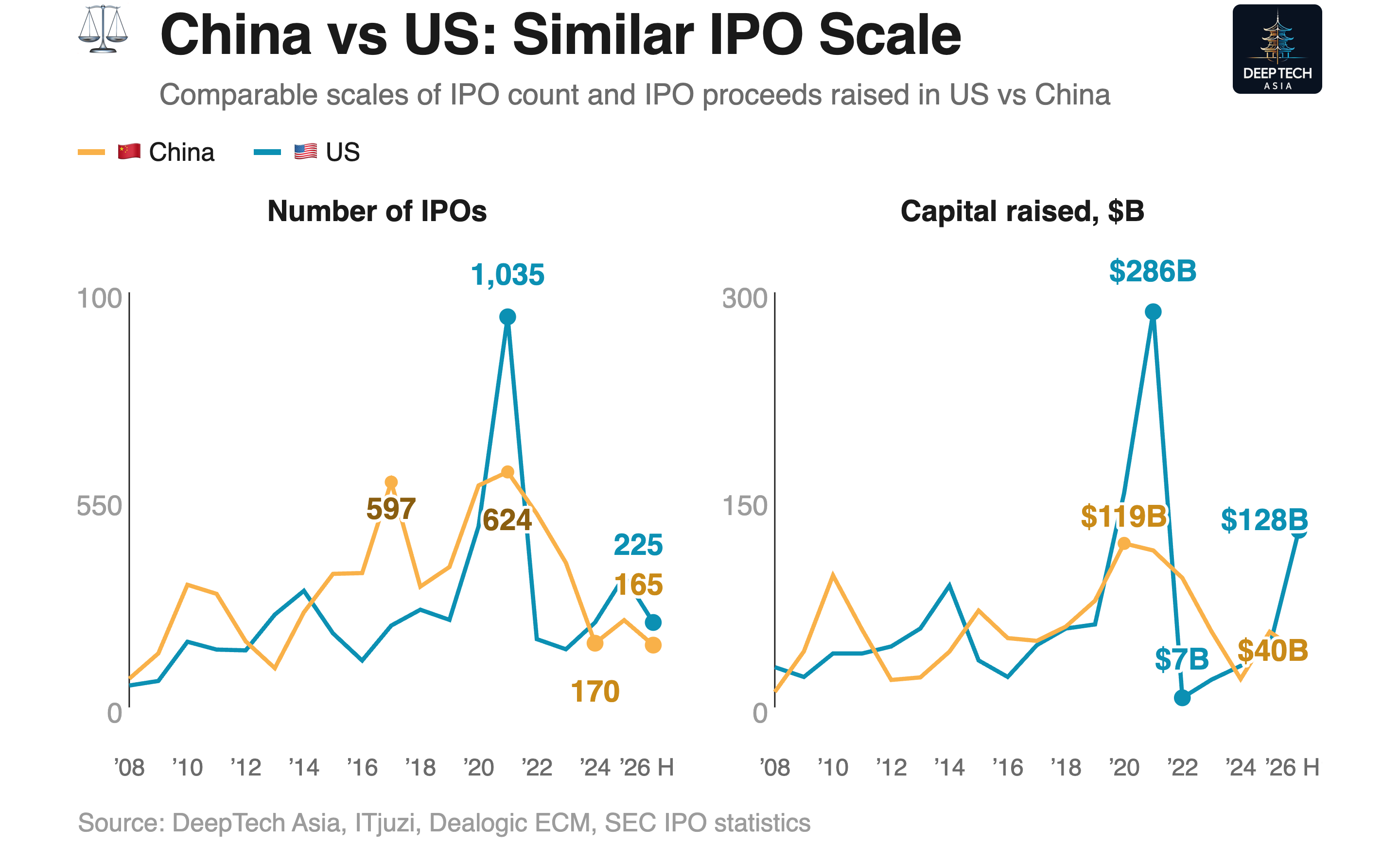
Although the US remains the world’s largest IPO market, China’s IPO activity has been broadly comparable since 2008, both in the number of listings and capital raised.
Moreover, IPOs in China have been generating higher returns than US IPOs for the past three years. Among the cohorts of IPOs that happened since 2023, Hong Kong Stock Exchange (HKEX) has been consistently performing stronger than Nasdaq, both on the 1st trading day and after 6 months and 12 months, when the lock-ups expire.
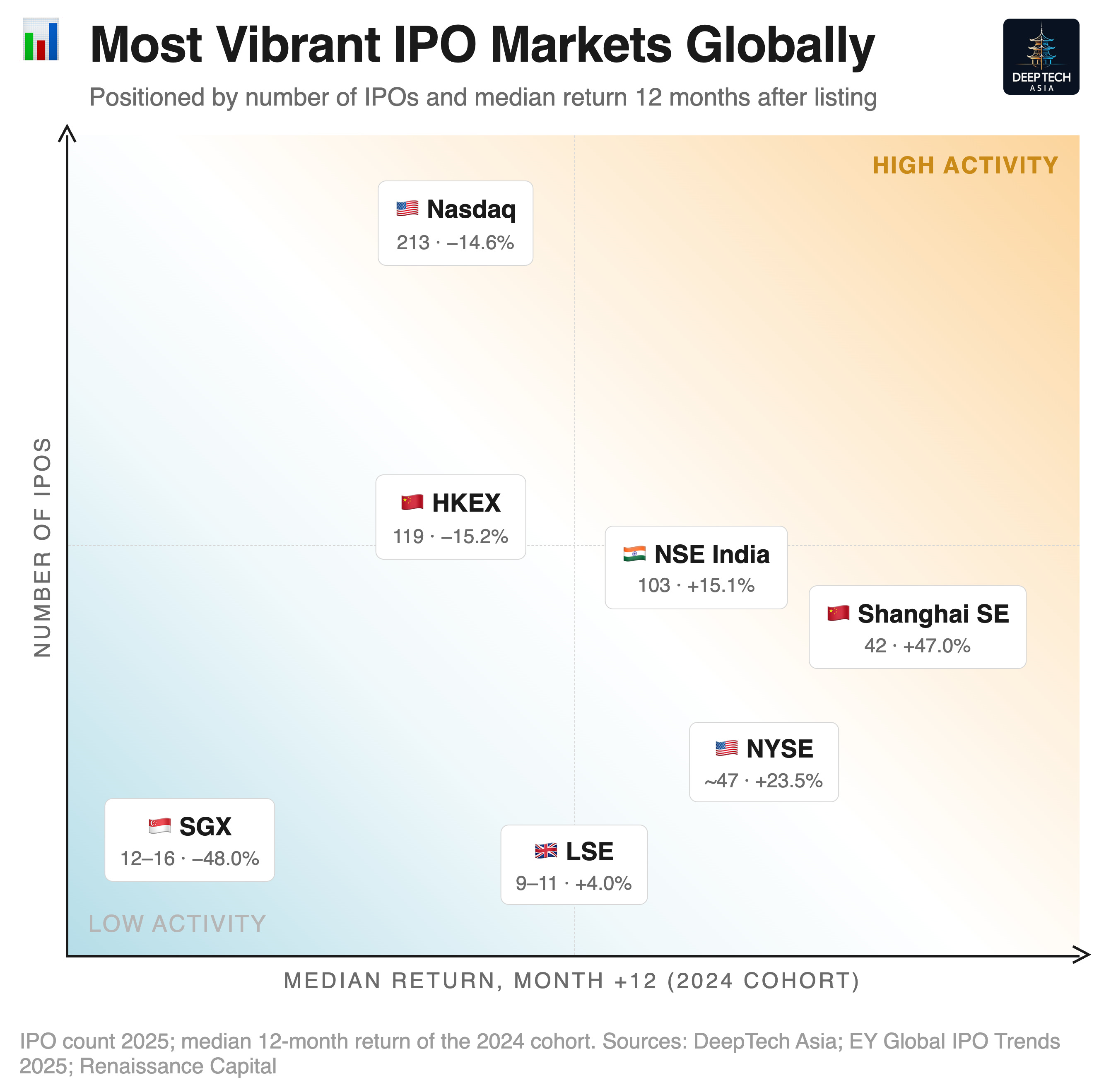
In 2024, Shanghai Stock Exchange demonstrated the highest median 12-month IPO returns among all global exchanges.
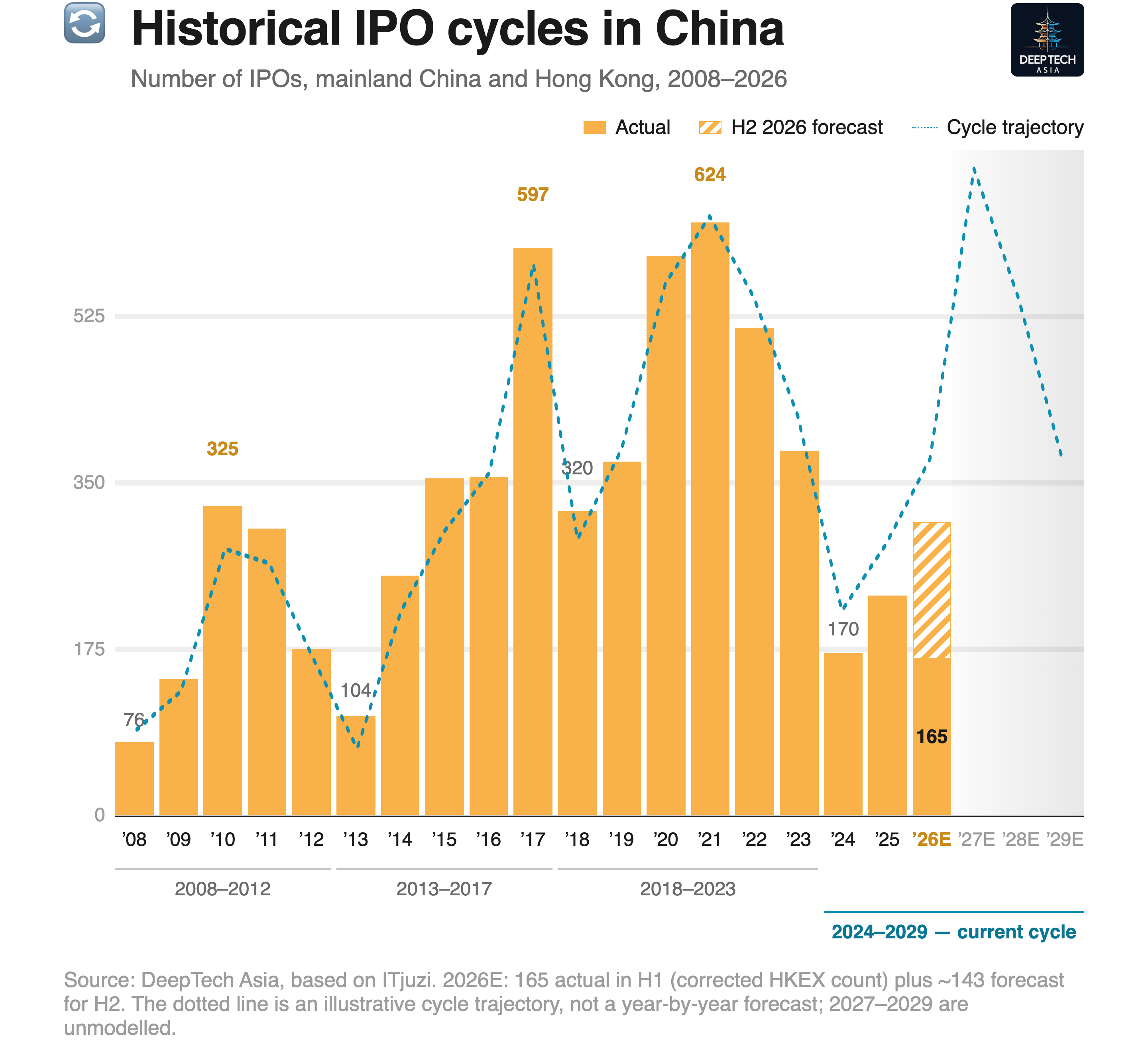
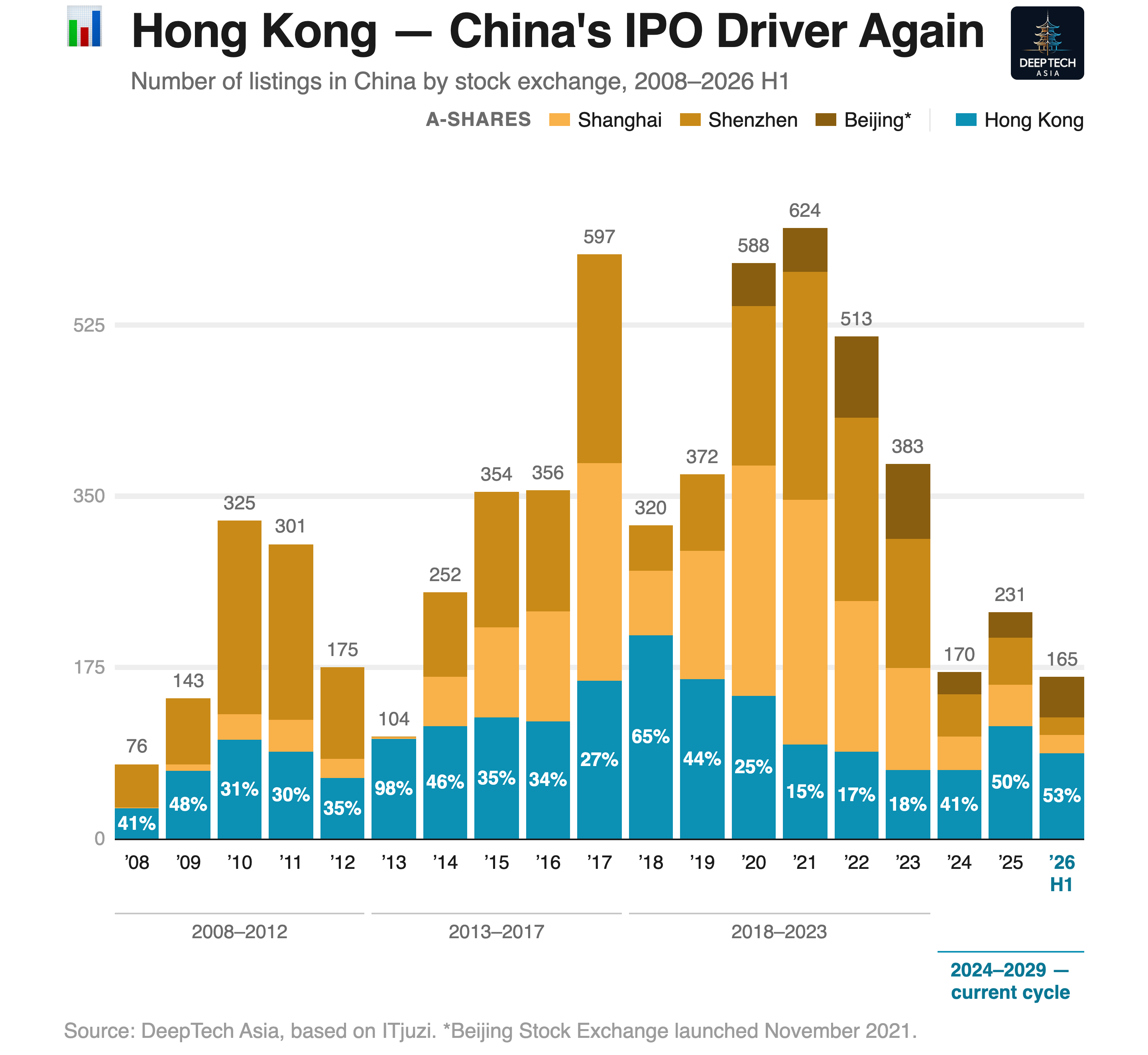
China’s IPO market has experienced several expansion and contraction cycles. The latest downturn brought combined Mainland and Hong Kong listings from 624 in 2021 to 170 in 2024, constraining VC exits and contributing to China’s “VC winter”.
One of the key questions for global investors deploying into China:
“How sustainable is the current IPO revival in China?”
Considering that VC market in China is very dependent on IPOs, we can also expand this question:
“How sustainable is China’s VC revival overall?”
China’s IPO history is the changing balance between Mainland and Hong Kong:
Hong Kong has long accounted for a substantial share of listings: roughly 30–48% in 2008–2012, rising to 65% in 2018 and 44% in 2019.
Mainland exchanges then drove the 2020–2021 issuance boom, while Hong Kong’s share fell to 15–18% in 2021–2023.
Recently, the balance has been shifting again. Hong Kong accounted for 41% of listings in 2024, 50% in 2025 and 53% in H1 2026.
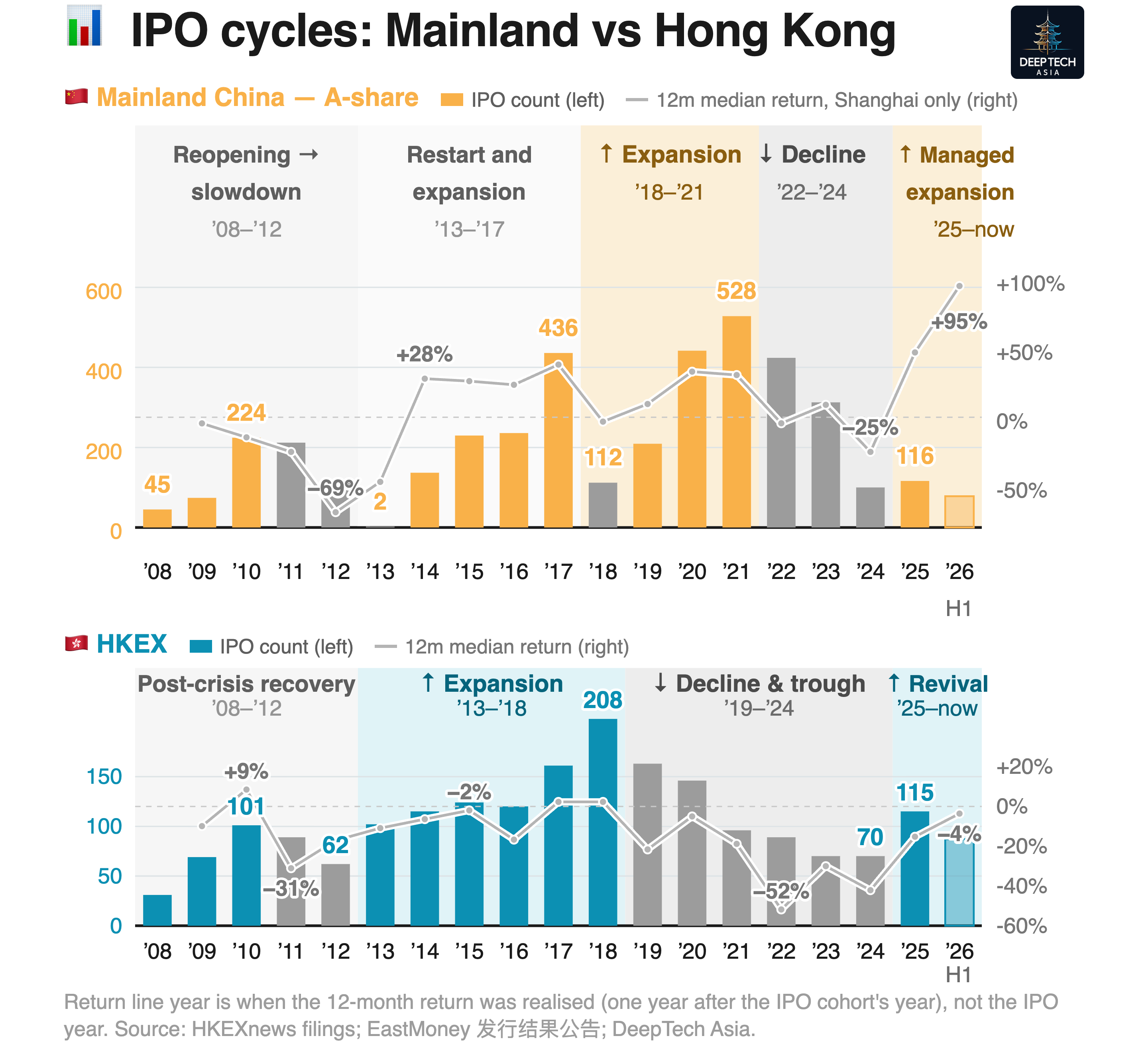
Mainland and Hong Kong IPO cycles have often moved out of sync:
2013–2018: Hong Kong listings expanded to 208, while Mainland issuance fluctuated sharply, reaching a peak in 2017 before falling in 2018.
2019–2024: Hong Kong entered a prolonged decline. Mainland issuance initially moved in the opposite direction, peaking in 2021 before also contracting.
2025 onwards: Both markets are recovering, but Hong Kong is rebounding faster. Mainland issuance remains more tightly managed, while Hong Kong is rebuilding activity towards previous cycle highs.
To explain the nature of these IPO cycles and try to forecast their further development, it’s crucial to analyse the key factors that are driving them.
We can measure the activity of any IPO market by two key north star metrics:
Number of IPOs — effectively supply-side of the market.
Median return — which can be a proxy to demand for the companies going public.
Supply side is driven mostly by:
IPO pipeline — the more high quality IPO applications the exchange has, the more supply of IPOs we could see in the coming months.
IPO alternatives — reflects whether the companies have any other meaningful liquidity options: either other IPO platforms or other exit routes (M&A, secondary sale, buyout etc).
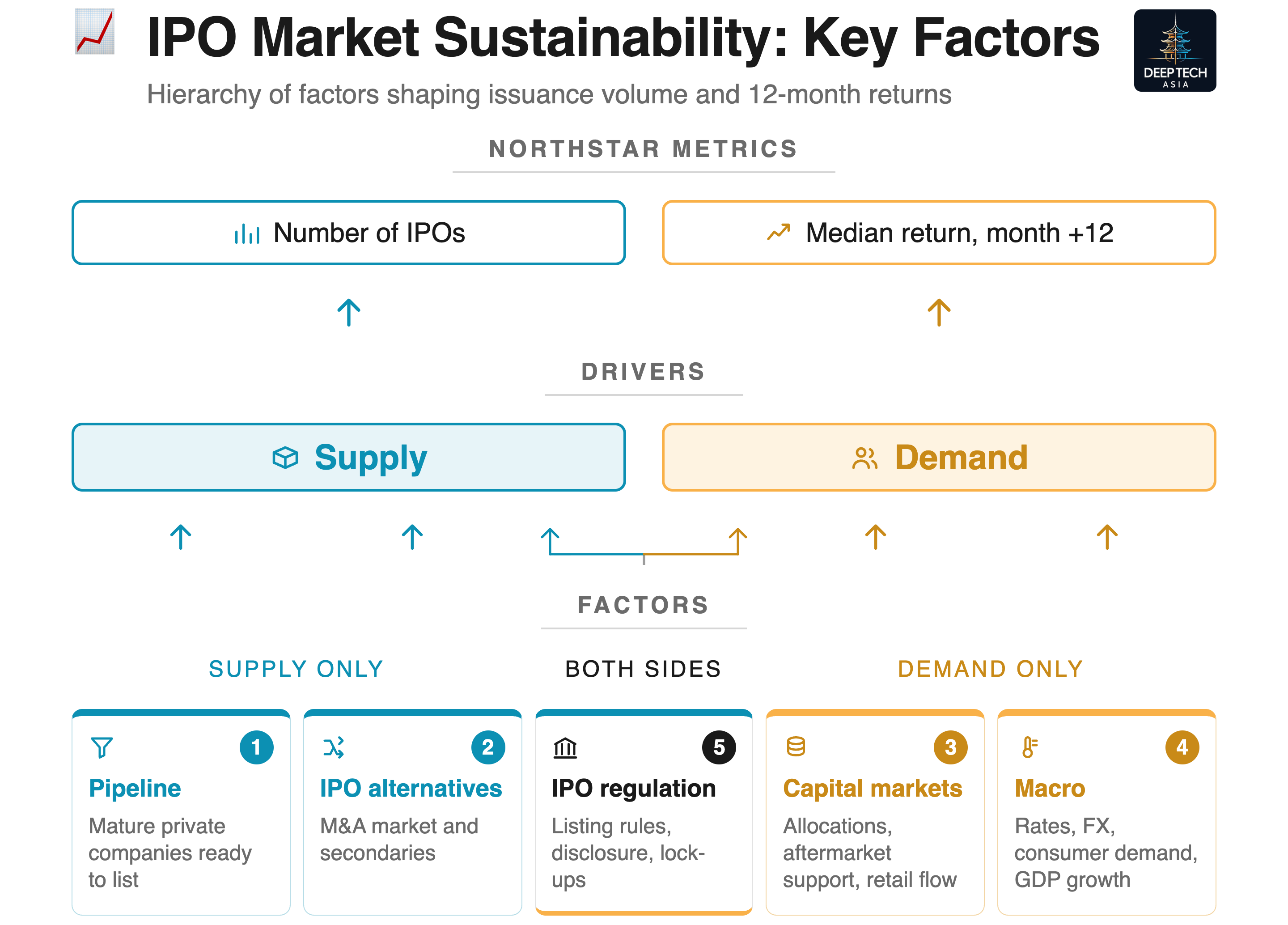
Demand side is driven by:
Capital markets — how liquid the public equity market are, retail vs cornerstone participation, trading volumes, investor sentiment and other aspects.
Macro environment — the general state of the global and national economies, as well as geopolitical factors.
Another important factor is IPO regulation that can drive both demand and supply. This includes specific IPO-related rules, restrictions, requirements etc.
Important to note that it’s very rare when only one factor drives the IPO trend at each stage of the cycle. Usually, there are several factors in play simultaneously, but among them there is still usually one factor (or maximum two factors) that is driving the others — the key factor.
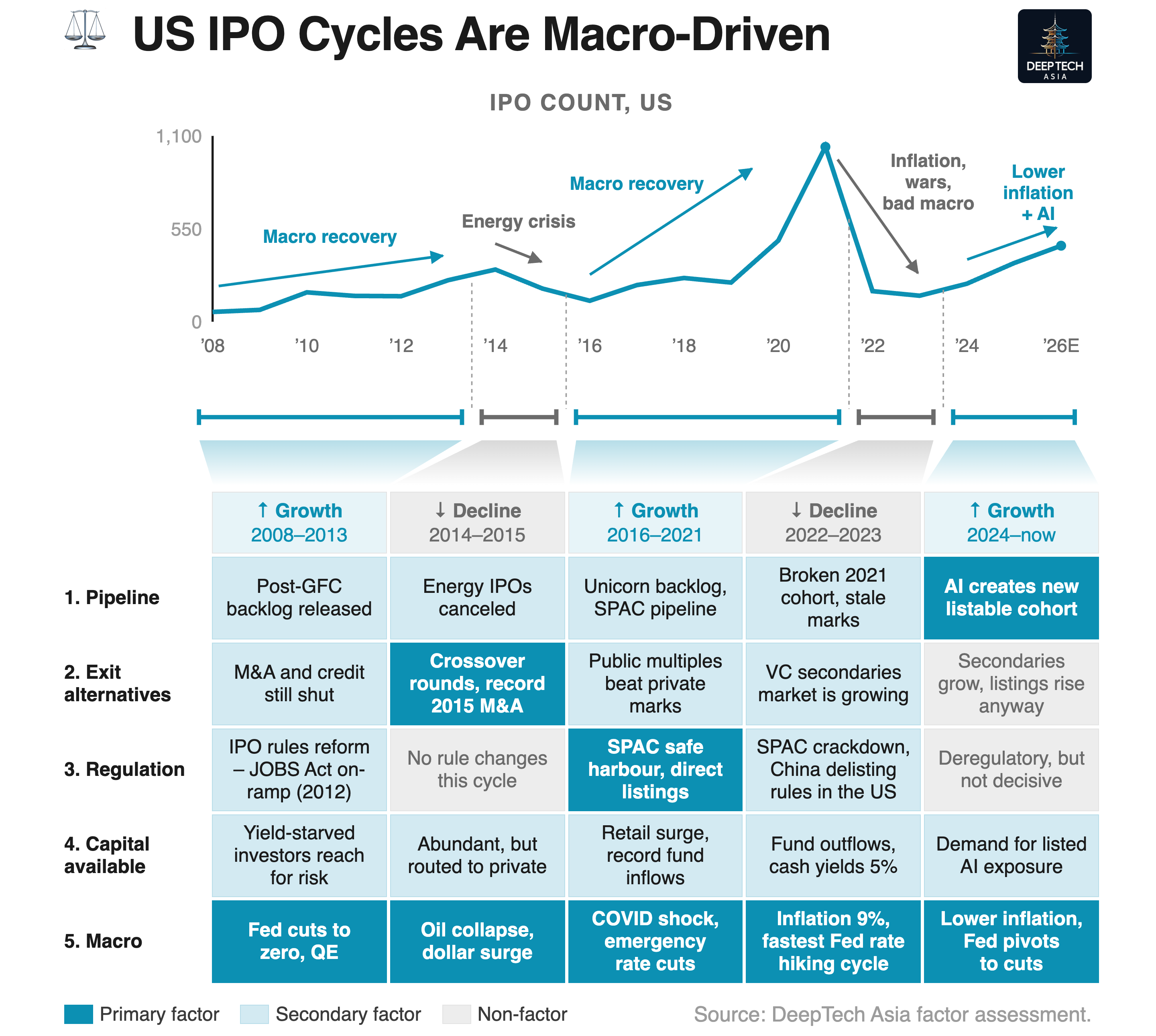
Above is the example of the US IPO market (mainly Nasdaq + NYSE). We can see that all IPO cycles in the US are driven by Macro, which makes sense for a pure capitalism economy with a free market. In most cases, the Capital factor reacts to the Macro factor.
All other factors, such as Pipeline, Regulation and IPO alternatives do have some impact, but they are secondary.
A-shares IPO Transition
The extreme opposite of the US is the A-share IPO market in China which is heavily dependent on the Regulation factor, although it functions as a response to some other factors.
Unlike the predominantly disclosure-based US IPO framework, Mainland China’s CSRC (China Securities Regulatory Commission, 证监会) actively manages IPO issuance according to market conditions and policy priorities. Meeting listing eligibility criteria alone does not guarantee that an IPO can proceed.
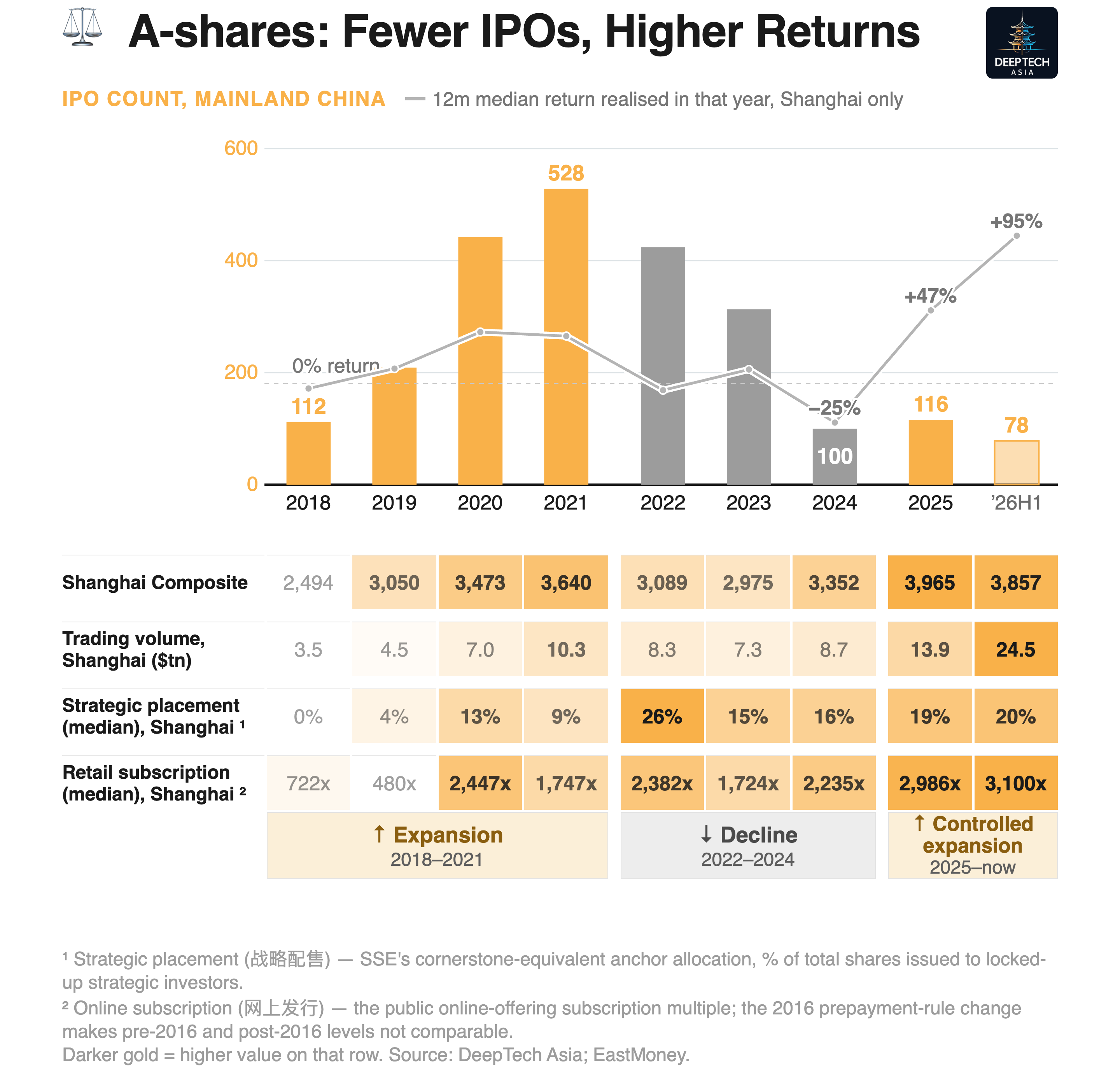
The year 2021 was a bright example:
Before 2021, China introduced strong measures to encourage IPO listings in Mainland instead of overseas: launched the STAR Market in Shanghai, reformed the listing process for ChiNext in Shenzhen. All this was fuelling investors’ interest in IPOs and companies’ desire to go public.
Eventually, it caused a huge influx of bad quality candidates going public in Mainland. During the 2019–2021 IPO expansion, regulatory inspections exposed weak financial disclosures, inadequate checks by sponsors and, in some cases, financial manipulation. By April 2020, 30 of 86 IPO applicants selected for inspection had withdrawn; in early 2021, seven of nine selected STAR Market applicants withdrew shortly after receiving inspection notices. CSRC even introduced a phrase — 带病申报 (dài bìng shēn bào) which literally means “applying despite being ill”.
All this led to diminishing returns of post-IPO investors, mainly retail investors who were effectively funding the exit proceeds of private VC investors and then suffered losses.
To protect retail investors, CSRC had to intervene: slowed down the IPO issuance and introduced higher requirements for IPO listings.
This led to a drastic drop in IPOs in Mainland China: from 528 in 2021 to ~100 in 2024.
The flip side was that A-share IPOs became the premium destination for any Chinese companies that wanted to go public — only the best ones can now list in Mainland China.
This has significantly increased the quality of A-share IPOs, especially in Shanghai, and boosted the returns of post-IPO investors. Now, Shanghai Stock Exchange is a highly liquid market with $24.5 trillion of trading volumes only in the first half of 2026 (vs $27.1 trillion on Nasdaq) and over 3000x median retail IPO oversubscription.
The companies with the highest 12-month IPO returns include:
HyperStrong (海博思创): +1,085%
Dameng Database (达梦数据): +596%
Intsig (合合信息): +288%
Insta360 (影石创新): +246%
Shanghai Stock Exchange also hosted some blockbuster IPOs in the last 12 months:
MetaX (沐曦): +693%
CXMT (长鑫): +466%
Unitree (宇树): +460%
Moore Threads (摩尔线程): +425%
SJ Semiconductor (盛合晶微): +289%
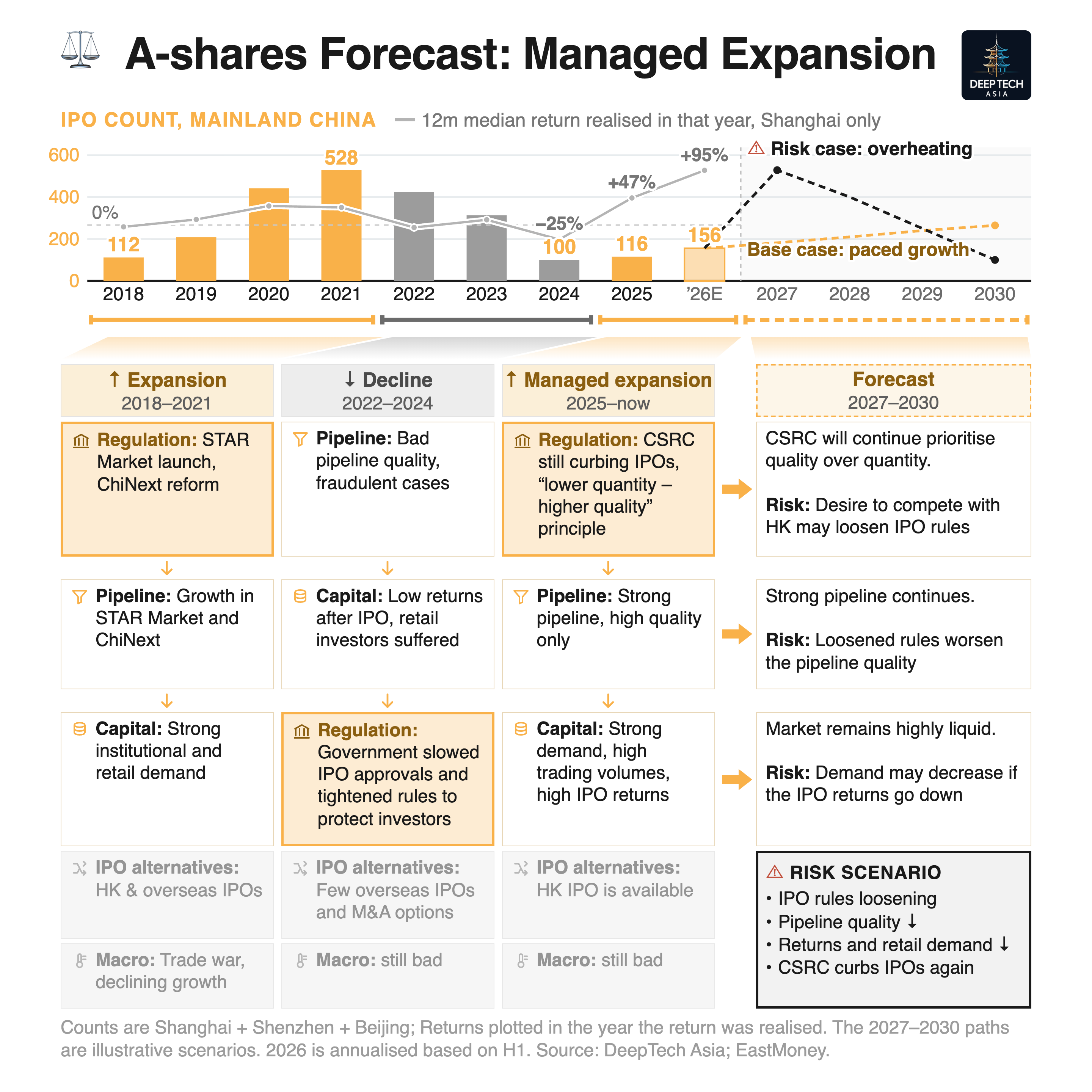
Now, it seems that CSRC will stick to its strategy of “quality over quantity”, but there are some aspects indicating that this trend can change at some point:
Limited number of IPOs means a lower number of exits for startups and VC investors. This leads to a disproportional value concentration among a narrow circle of startups, which is not good long-term for competition and a vibrant VC ecosystem.
A-share listings are very policy-driven: deep tech companies solving the priority tasks of the Five-Year plan have much higher chances of getting listed, even despite being loss-making.
There are some indications that Mainland exchanges are trying to compete with HKEX for the IPOs.
All these factors may prompt the regulators to lower the IPO requirements again to increase the funnel. This may worsen the pipeline quality again and eventually trigger the same reset as in 2021. We already see early signs of this trend with the recent blockbuster IPOs of Unitree which saw their stock fall drastically after the 1st trading day (~50%).
Hong Kong’s Next IPO Revival
I believe the HKEX revival may solve some of the issues related to the A-share IPOs.
Right now, we are observing the bifurcation of IPO markets in China:
A-shares becoming more “premium”: high quality, low quantity.
HKEX capturing the “mass market”: rapid increase in IPO count, attracting those who can’t go public in Mainland China or overseas, sometimes sacrificing returns.
HKEX historically have been a hybrid between market-driven western exchanges and policy-driven Mainland markets.
Since 2013, the HKEX IPO market was rapidly growing, driven mainly by a favourable global and Chinese macro.
Regulation played its role (e.g. Stock Connect launch), but it wasn’t the primary driver.
At that time, Hong Kong was very much dominated by global capital, first of all, by US funds that were optimistic about China’s economy.
The trend reversed in 2018:
Same as expansion, the decline was driven by macro factors, such as the US-China trade war, slowing GDP growth, COVID and property crisis.
The situation deteriorated further as China intensified its regulatory crackdown on the tech sector: Ant Group’s landmark IPO was cancelled in late 2020, followed by restrictions on edutech, e-commerce, gaming and other industries.
Together, these factors severely undermined investor confidence in China, both overseas and even domestically, and sharply reduced demand for new IPOs.
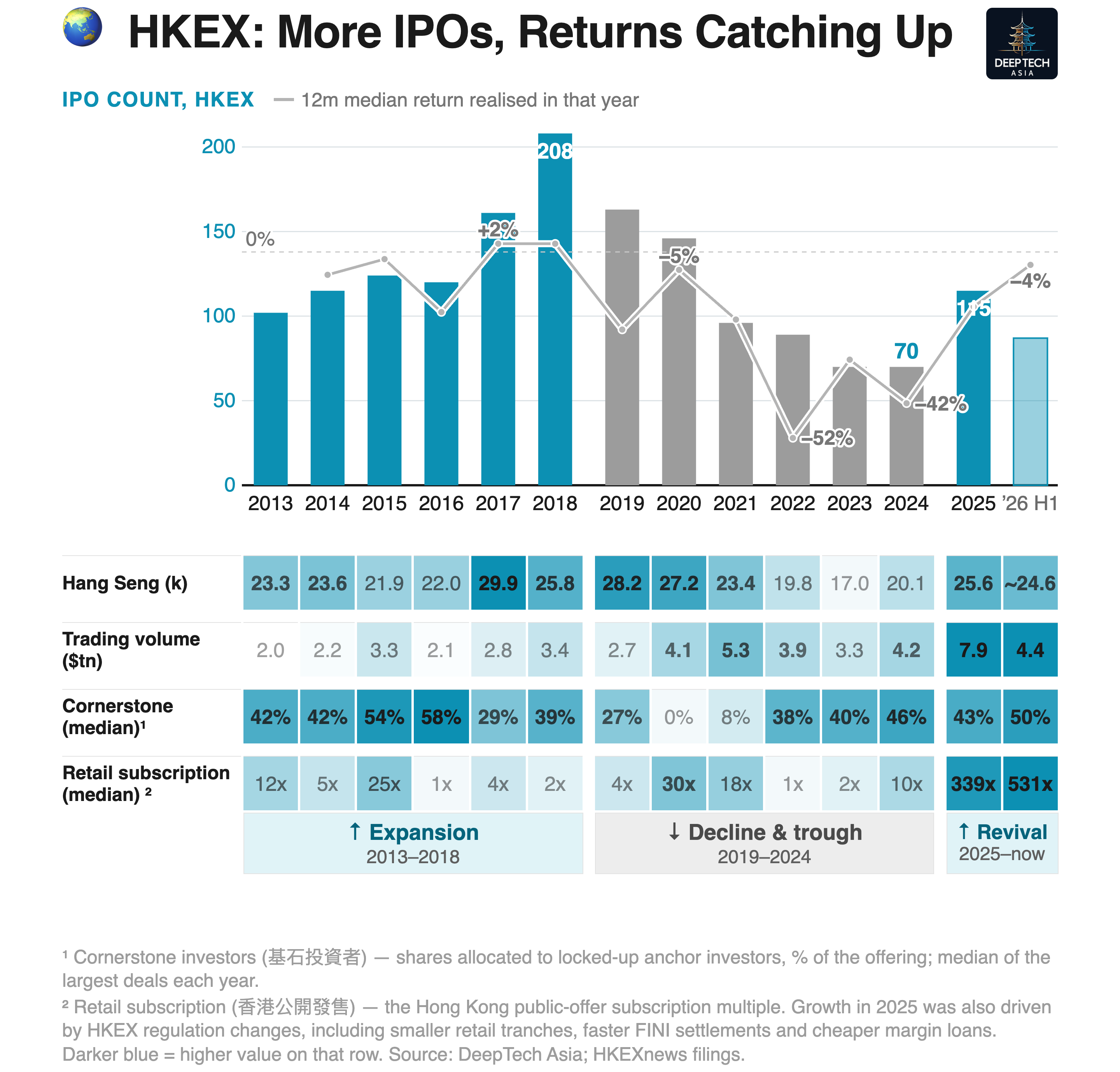
It took HKEX five years to recover from this shock. But eventually, it was the regulation that triggered the revival of the HKEX IPO market once more.
The regulators introduced a range of measures encouraging companies to go public in Hong Kong. The so called A+H fast-track channel was introduced — an easier way for A-share public companies to list in Hong Kong.
The capital inflow coincided with the “DeepSeek moment” and the general enthusiasm in China’s AI and broader tech sector and its potentially significant role in the global landscape. This prompted global investors to return to Hong Kong once again in search of exposure to the next generation of Chinese tech champions.
This was happening under the poor macro conditions, which proved again that Hong Kong had clearly shifted more towards the Mainland policy-driven model.
The results of these incentives were impressive:
HKEX became again the world’s largest IPO market in 2025 (by IPO capital raised) and now is on track to host over 200 IPOs in 2026, which is close to the previous 2018 annual record of 208 IPOs.
Trading volumes reached all-time highs — $7.9T in 2025 and $4.4T in the first half of 2026 alone, compared to the average $3-4T annually in the last ten years.
Retail IPO oversubscription (median) skyrocketed to over 300x in 2025 and 500x in 2026, against low double-digit numbers before. This is partly driven by HKEX regulation changes (smaller retail tranches, faster FINI settlements and cheaper margin loans), but also by growing demand.
12-month post-lockup IPO returns (median) also recovered to the “pre-trough levels” of roughly 0%, although still much lower than for A-shares.
Cornerstone participations are also stronger in this cycle than in the previous expansion cycle that ended in 2019, which along with the strong retail demand may provide downside protection.
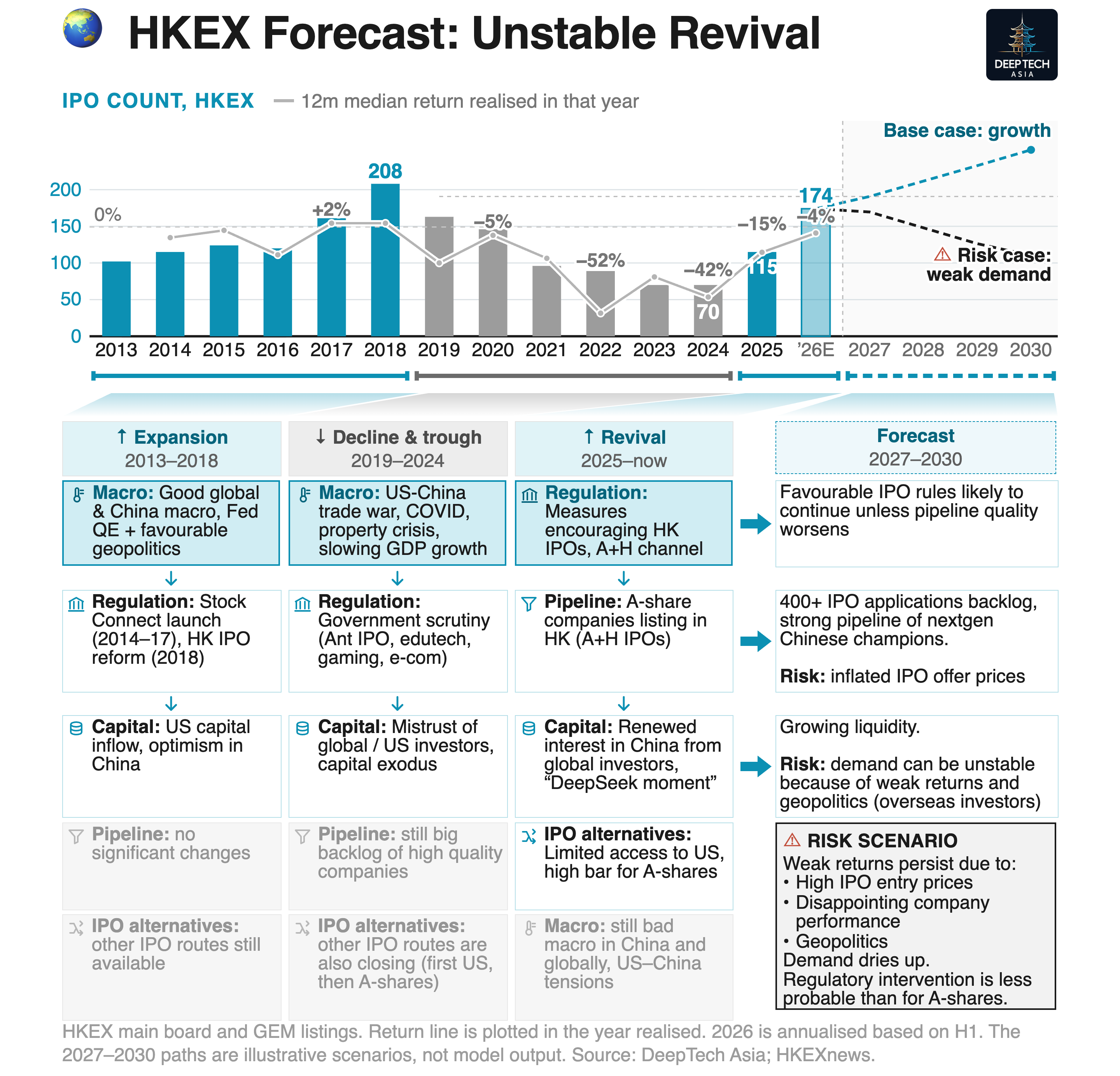
All this supports an optimistic outlook for Hong Kong IPOs, but in reality there are tangible risks that could reverse the positive trend:
Unlike A-share IPOs, which tend to be priced conservatively, companies expected to list in Hong Kong later this year and next — including Moonshot AI and Red Note — already reached high private-market valuations. This could leave limited upside for investors buying at or after the IPO.
Unlike A-share IPOs, the median of post-lockup IPO returns in Hong Kong is still below 0%. Although it’s not uncommon for tech IPOs (similar to Nasdaq), unless 12-month returns consistently stay in a positive double-digit territory, the investor demand may sooner or later dry up.
Unlike A-share IPOs, HKEX is still more vulnerable to geopolitical and macro shocks. While macro is less likely to get even worse now, geopolitical factor remains unpredictable and could once again deter Western investors just as their confidence in Chinese investments begins to recover.
Based on these, I would imagine three different risk scenarios:
Weak demand → gradual IPO decline (moderate probability).
Both global and domestic retail investors lose interest in HK IPOs, only cornerstone investors remain.
Companies could once again become reluctant to list in Hong Kong. This would likely unfold gradually over several years, but the risk is substantial.
Another crackdown → sharp IPO decline (low probability).
The repetition of the government crackdown on the tech sector in 2020-2021 would have a catastrophic impact on IPO markets, as global investors would lose faith in China’s investment thesis again. Domestic retail investors would prefer other less-risky investments.
But this scenario is very unlikely, because the previous shock was meant to solve a lot of fundamental challenges in tech sector (e-commerce monopoly, fintech regulation, over-commercialisation in education).
Now these problems are solved and the government is actively encouraging strategic high-tech industries.
There may be targeted restrictions on specific industries, as we are already seeing in humanoid robotics, which Chinese regulators increasingly view as overheated.
But many other fundamental areas — like AI, compute, space, energy — will most likely be encouraged further, as they are important for winning the tech race with the US.
Geopolitical shock → moderate IPO decline (unpredictable).
Now restrictions are mostly related to US investors in private and some public Chinese companies. The overseas investor demand in HKEX is driven by a wide range of geographies, including Europe, Middle East and Southeast Asia, but also US, Japan and other “sensitive” regions.
Any geopolitical escalation may force some overseas investors to promptly reduce their exposure to China, but it would most likely concern more “sensitive” countries, like US, Japan, perhaps Europe.
At the same time, there still will be other overseas investors which are more aligned with China, for example, Middle East, Southeast Asia, Central Asia.
Moreover, the domestic retail investors would most likely also keep their exposure or even increase it if they would lose access to Western investments.
This is why I don’t think that the geopolitical factor would cause a massive decline of IPO activity in Hong Kong.
What Can Go Wrong In The Future?
To summarise, I believe Hong Kong will now play again a crucial role — both in China’s IPO market and in China’s VC sector.
IPO remains essential for VC exits in China, as the M&A and VC secondaries are still underdeveloped.
Nowadays, we observe the bifurcation of China’s IPO market:
Mainland IPOs are premium platforms with fewer listings, but vast liquidity and potentially strong returns.
Hong Kong is likely becoming an even more massive IPO market than it used to be, assuming the role of the main IPO destination for Chinese companies.
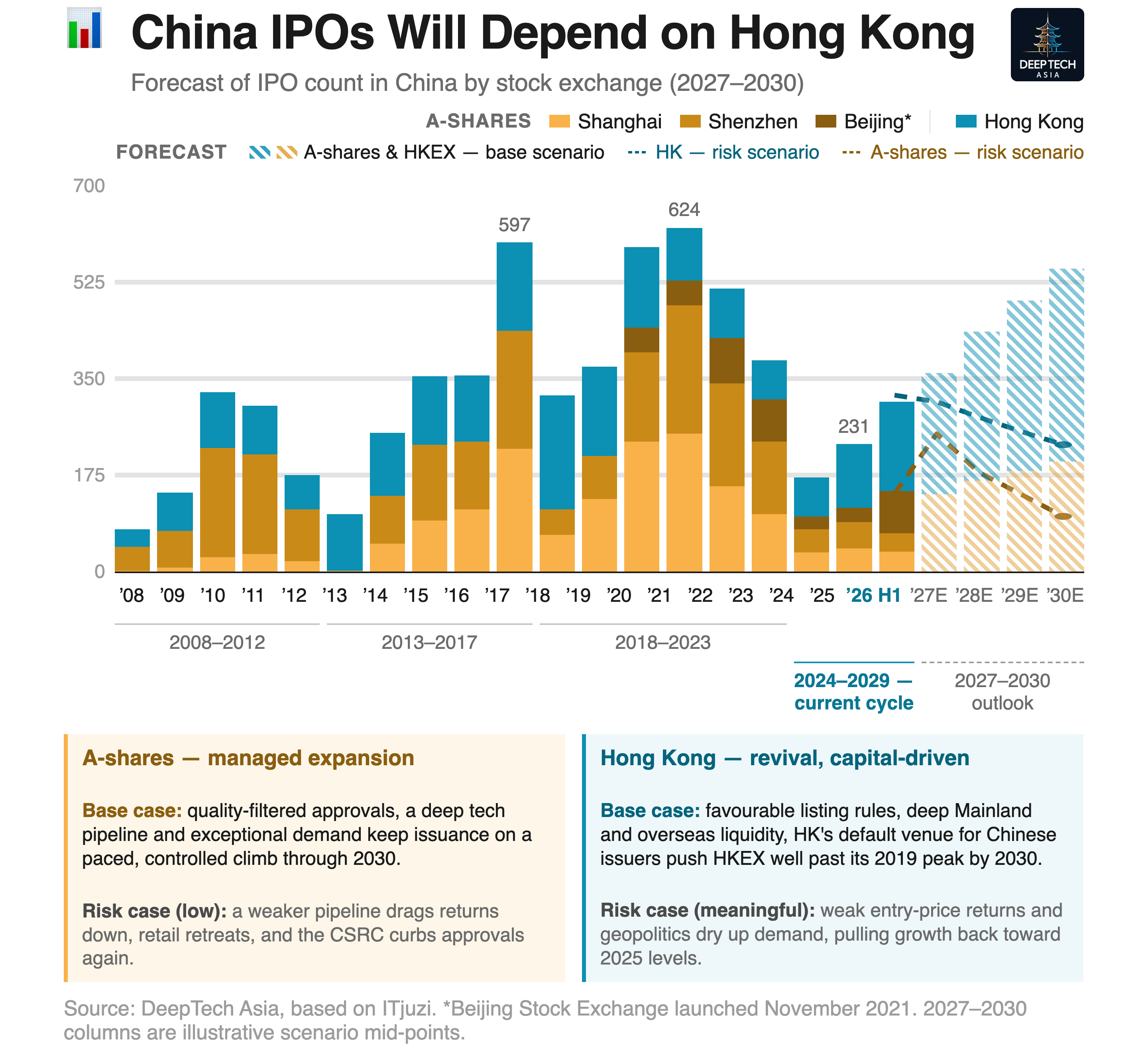
While Mainland IPOs will most likely maintain a moderate pace in the interest of quality, Hong Kong’s expansion is supported by healthy underlying metrics, including rising trading volumes, strong retail participation and improving post-lock-up returns.
However, rapid expansion creates its own risks. Three scenarios in particular could undermine the longer-term prospects of China’s IPO and VC markets:
1. Weak demand
Weak investor demand driven by poor IPO returns is probably the most important risk. If new listings consistently underperform after lock-ups expire, enthusiasm from both domestic and overseas investors could fade, making future IPOs harder to price and weakening the VC exit environment.
How to spot it?
Track median post-lock-up returns, trading volumes and retail participation.
Watch subscription levels and pricing discounts.
A simultaneous deterioration across these metrics could signal the beginning of the next Hong Kong IPO down-cycle.
2. Government crackdown
A broad intervention similar to 2020–2021 would be highly damaging, although I consider it unlikely. A more plausible scenario is a targeted intervention in overheated sectors, where valuations and fundraising run too far ahead of fundamentals, for example, in humanoid robotics.
How to spot it?
Track CSRC guidance, government announcements and IPO approval trends.
Watch for repeated official concerns around speculation, valuations or excessive competition.
Sector-wide IPO delays and withdrawals are another warning sign.
The impact can be drastic, but there are usually early signals.
3. Geopolitics
Geopolitics remains the least predictable risk. While the impact on China’s domestic VC market may remain limited, a major escalation could jeopardise overseas investor exposure, particularly from the US and potentially Europe, Japan and the UK.
The main risk is not necessarily deterioration in the underlying company, but losing the ability to own, finance or exit the investment. This could happen through:
Home-country restrictions forcing investors to stop investing or divest.
Sanctions affecting Chinese banks, brokers or other financial infrastructure.
Companies themselves removing politically sensitive foreign investors from their cap tables.
Chinese retaliation through investment, transaction or capital-transfer restrictions.
A fire sale, where many Western investors need to exit while the pool of eligible buyers shrinks.
Advice for Western Investors
Western investors cannot eliminate geopolitical risk, but they can reduce the potential damage.
1. Shorten investment horizons. Late-stage and pre-IPO investments generally face less geopolitical uncertainty than positions requiring seven or ten years to exit.
2. Preserve transfer flexibility. Pay close attention to transfer restrictions and company approvals. Fund or SPV structures may sometimes make transfers easier.
3. Prioritise Hong Kong over Mainland IPO routes. Hong Kong retains a degree of autonomy and operates outside Mainland China’s capital control framework. While it is difficult to predict how this would play out in a severe geopolitical escalation, capital repatriation from Hong Kong-listed companies would likely remain easier than from A-share companies. Even amid rising geopolitical tensions, China continues to preserve Hong Kong’s role as a “window to the outside world.”
More broadly, China is too deeply integrated into the global economy for a major decoupling to happen quickly — if it happens at all. Even under severe geopolitical escalation, any separation would likely be gradual and highly costly for all sides.
If you have any proposals, ideas, or feedback, we’d love to hear from you! Feel free to reach out at denis@deeptech.asia or on LinkedIn. Let’s connect and explore how to improve together.