

Special thanks to Poe Zhao, Grace Shao, David Li, Jialin Yang, Yan Zhang, Chris Jin, Neil Gong, James Jin for contributing to this article.
Summary:
China’s neoclouds remain small: by my estimates, VC-backed providers capture just 4.5% of AI cloud spending, versus 21% globally.
The Western model thrives on scarcity: fast deployment, cheaper compute, long contracts and NVIDIA’s support help independent clouds scale.
China has a different bottleneck: advanced chips are scarce, but data-centre capacity is abundant, weakening the advantage of building faster.
Incumbents have stronger advantages: hyperscalers and state operators benefit from access to chips, financing and approvals; telcos also offer a neutral alternative to independent labs.
Two paths could unlock growth: overseas expansion and serving China’s growing independent AI labs. Replicating the Western model alone is unlikely to be enough.
In the last three years, the growing demand for compute gave birth to the whole new industry of the specialised AI cloud providers — neoclouds.
Crusoe raised a $3.9B Series F at $30.9B valuation. Fluidstack’s reported a $1.5B fundraise at a valuation above $18B. CoreWeave and Nebius are public companies with $30B+ market cap each.
Neoclouds are well positioned to become a third pillar of AI compute, along with hyperscalers and on-premise data centers.
China is the world’s second-largest AI market. Why don’t we see Chinese neoclouds?
The global landscape of AI cloud providers is quite complex:
Colocation providers that only provide data center infrastructure (building, energy, connectivity), but not compute itself. Lancium, IREN, Applied Digital are the biggest VC-backed companies in this space. Most of them are already public.
Vertically integrated neoclouds — the likes of Nebius, Crusoe, Nscale. They own the full stack: infrastructure, compute and software for AI training and inference.
Asset-light neoclouds — like CoreWeave, FluidStack, Lambda, Together AI — are similar to the previous group, but they usually use someone else’s data center infrastructure.
Software-only inference platforms (Model-as-a-Service, MaaS) — Fireworks AI, Baseten, DeepInfra are the typical examples. They rent GPUs from other providers (e.g. neoclouds, hyperscalers) and sell AI token or model endpoints.
GPU & token marketplaces — don’t own GPUs, but just connect demand with the most optimal compute supply. OpenRouter is one of the brightest examples.
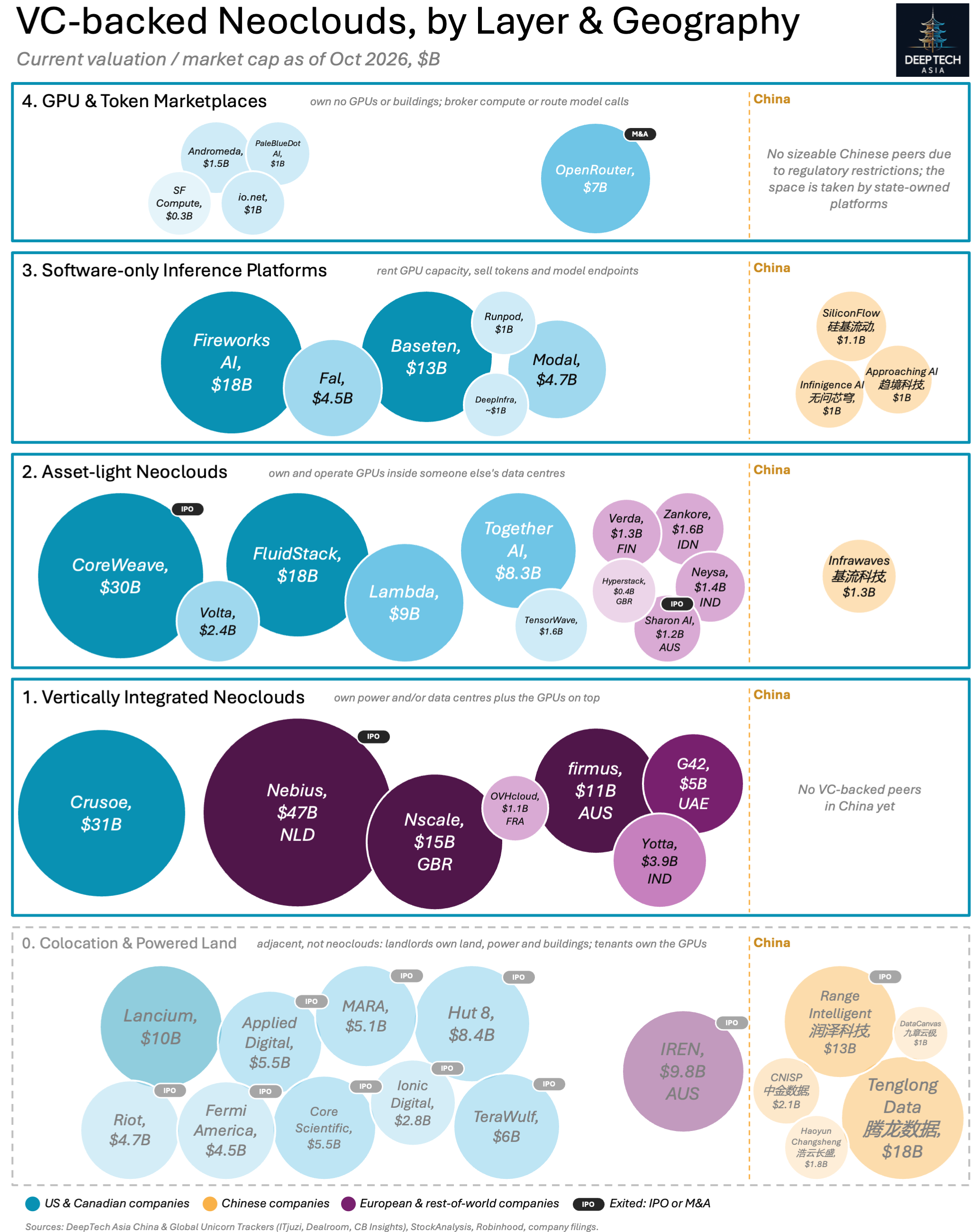
In China, the layer of VC-backed neoclouds is very thin:
No Nebius-like VC-backed full-stack players. This space is dominated by hyperscalers (Alibaba, Tencent, Huawei Cloud etc) and telcos.
Infrawaves (基流科技) is the only neocloud unicorn in China that operates their own compute and acts as a “token factory”.
Most unicorns are software-only inference platforms: SiliconFlow (硅基流动), Infinigence (无问芯穹) and Approaching AI (趋境科技), renting compute from other providers and selling APIs (pure MaaS model).
There are no pure VC-backed comparables to OpenRouter in China. SiliconFlow also has a similar single-entry platform for multiple LLMs, but it’s only for its own inference clusters. Other comparables are a seed-stage startup TokenRhythm (基元律动), or platforms within other established companies, such as Qiniu Cloud (七牛云) or NetEase’s ThinkFlow or Tencent’s TokenHub. One of the key reasons is regulatory hurdle for hosting any foreign LLM in China.
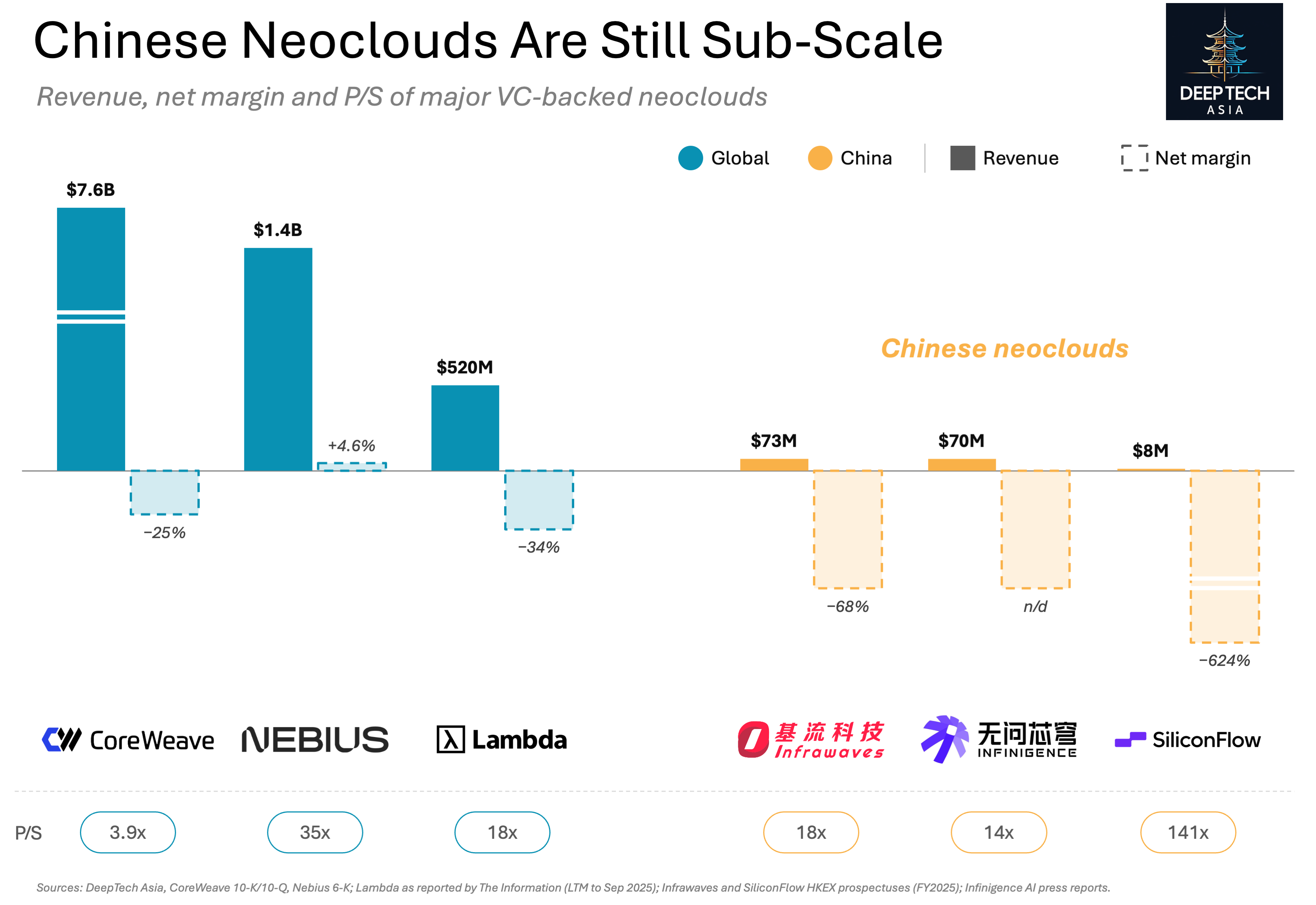
The gap in commercialisation is quite wide. While Coreweave and Nebius already count their revenue in billions and are close to profitability by net margin, their Chinese peers still generate less than $100M annual revenue while showing significant burn.
The margins of Chinese neoclouds are also quite thin, as many of them still earn money mostly from being the “second landlord” (二房东) — effectively reselling the bulk compute capacities to retailers.
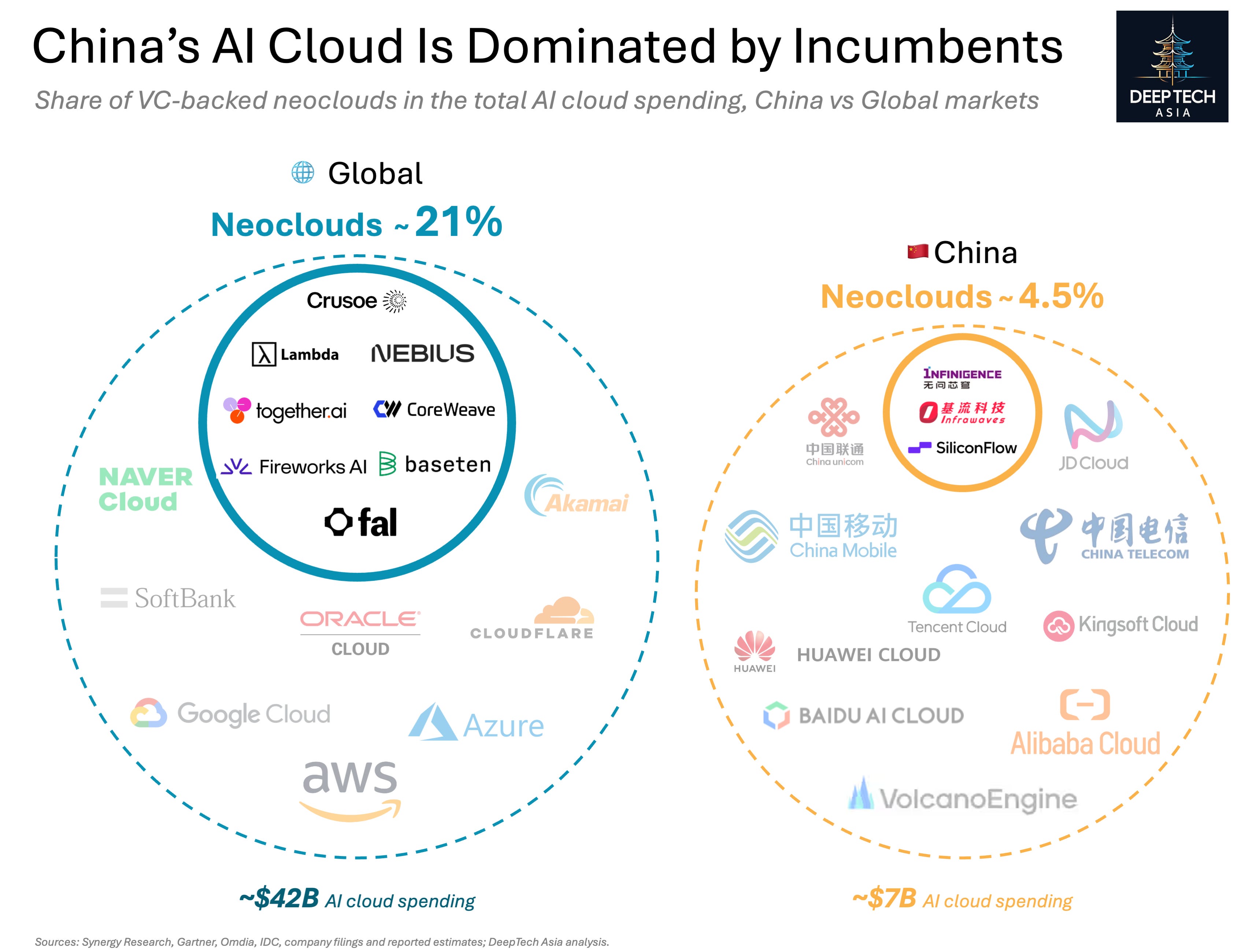
Chinese neoclouds also account for a very small market share out of the total AI cloud spend in China. According to my analysis (see methodology at the end of the article), global VC-backed neoclouds account for roughly 21% of the global AI spending, while in China this share is only 4.5%.
The rest is allocated among hyperscalers, telecom operators and other AI cloud providers.
Why is the situation so different in China?
To answer this, we need to do a recap on the question below.
Why Neoclouds Became So Large Globally?
I see five main drivers.
1. Demand outpaces supply
Because of AI, demand for compute is surging, but hyperscalers can’t build data centers fast enough:
Compute supply is constrained: enterprise-grade NVIDIA GPU lead time may well exceed 12 months.
Data center infrastructure is hard to scale quickly: energy grid and generation source, but also regulatory approvals for building more data centers.
2. AI-focused neoclouds build faster and charge less
Purpose-built architecture (InfiniBand) of neoclouds with liquid cooling and no virtualisation overhead is better designed for large scale training and inference than the general-purpose buildout of hyperscalers.
ESG compliance of large corporations like Google or Microsoft prevents them from building fast. Smaller neoclouds are less vulnerable to these hurdles.
Energy background of several neoclouds such as CoreWeave (originally an Ethereum miner), Nscale (Arkon Energy spin-off) and Crusoe (bitcoin miner) gave them a head start on deploying GPU clusters.
Cheaper price. Hyperscalers carry broad portfolios, legacy architecture and support overhead, so they target higher gross margins. Neoclouds price GPU-hours well below them and charge little or nothing for data egress.
As a result, in October 2026 H100 prices were $4–4.50 per GPU-hour at Lambda and Nebius, versus $6.90 at AWS and $11–12 at Google and Azure on demand.
3. Long contracts support borrowing
Multi-year purchase commitments from large customers help neoclouds finance GPU purchases through GPU-collateralised loans (infra lending, private credit).
CoreWeave reported a $104B backlog in June 2026, with Microsoft, Meta and OpenAI among its major customers, alongside roughly $35B of debt.
4. Nvidia supports independent clouds
Nvidia’s investments and GPU supply relationships help neoclouds scale. They also expand its customer base beyond hyperscalers developing alternatives such as TPU (Google), Trainium (AWS) and Maia (Microsoft).
5. Model developers want neutral suppliers
Hyperscalers also develop competing models. Independent compute providers offer labs an alternative without the same direct conflict.
CoreWeave’s customers include OpenAI, Meta and Anthropic.
What About China?
Most of the statements below do not apply in China.
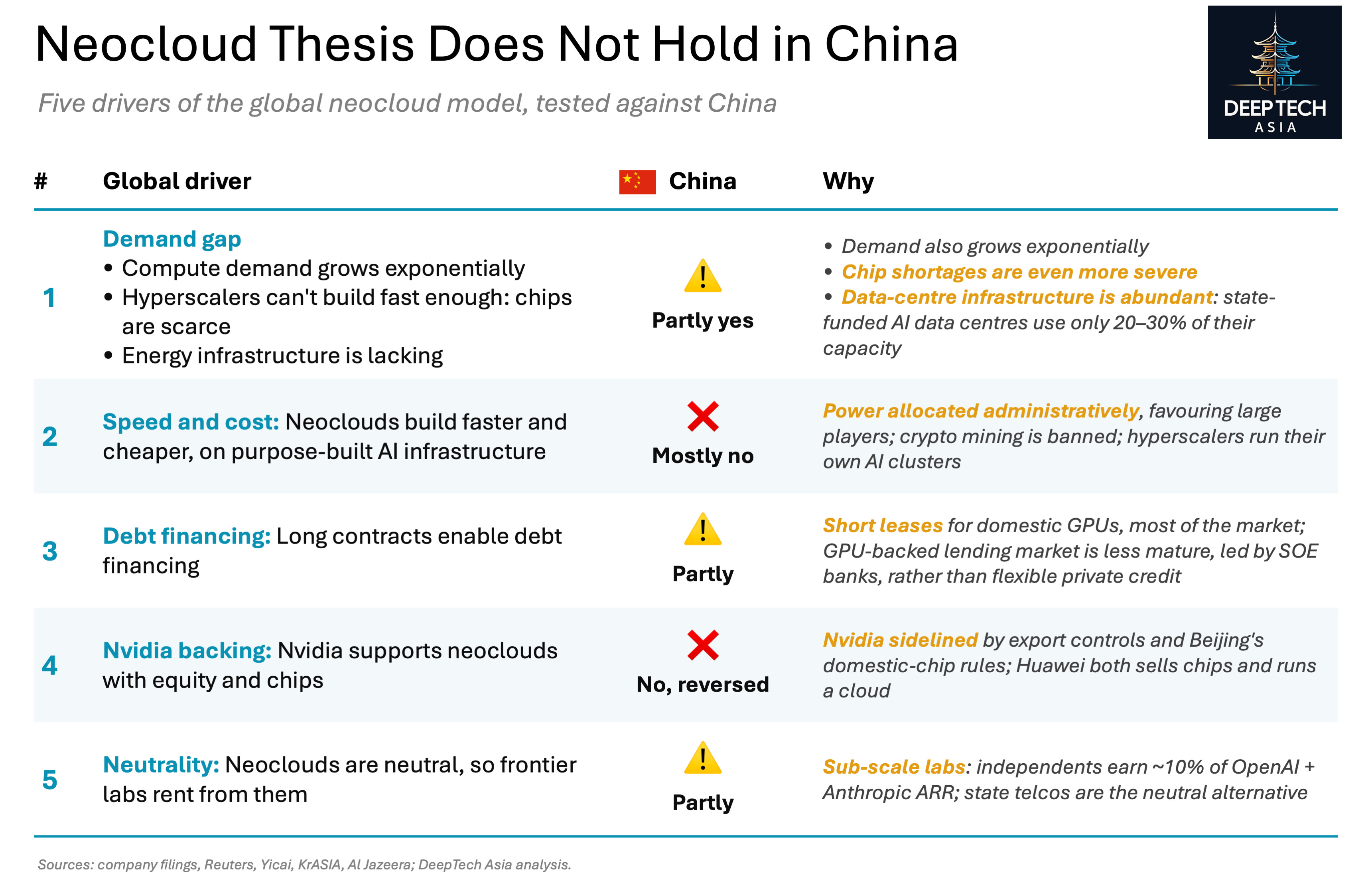
1. Data centers are not a bottleneck
AI demand in China is also growing rapidly, and chip shortages are even more severe, as NVIDIA GPUs are restricted, and local alternatives are still not as good.
But scaling data center infrastructure is relatively easy even for large hyperscalers. There are mega projects of state-funded AI computing centres in 30 cities. China has the world’s most advanced energy infrastructure with 430 GW of wind and solar capacities added in 2025 alone.
Meanwhile, data centers are reported to have 20-30% utilisation rates.
Access to energy doesn’t give such a strong competitive advantage in China as elsewhere.
2. Speed and cost offer less differentiation
Energy access is administrative, not market-based: local governments allocate power, energy-consumption quotas (能耗指标) and data-centre approvals, which favours hyperscalers, SOEs and large landlords over start-ups.
China banned crypto mining in 2021, so there are no IREN- or Core Scientific-style private players with ready sites and grid connections.
Purpose-built is no edge: Chinese hyperscalers run dedicated AI clusters and their own AI software stacks (e.g. Alibaba Bailian, Volcano Engine Ark).
3. GPU-backed lending is less mature
Lease terms are short for domestic (non-NVIDIA) GPUs, which make up most of the market, so it’s hard for Infinigence or Infrawaves to secure the same scale of $104B multi-year backlog as CoreWeave does.
A GPU-backed lending market exists but is less mature than in the US: the key lenders are SOE banks, rather than flexible private-credit providers.
4. There is no China’s NVIDIA
Export controls limit NVIDIA supply.
New state-funded data-centre projects must use domestic chips.
Huawei, a major domestic supplier, also operates its own cloud. Its incentives to support independent providers differ from NVIDIA’s.
It’s also hard to imagine the NVIDIA’s style “circular financing” in China due to regulatory reasons.
5. Neutrality is less of an issue
Independent AI labs are still sub-scale. Moonshot, DeepSeek, Zhipu are much smaller than OpenAI and Anthropic in terms of revenue. That leaves fewer large customers for independent clouds.
Telcos are a good neutral alternative for those who seek alternatives to hyperscalers. China Mobile, China Telecom and China Unicom report around 230 EFLOPS of combined computing capacity; China Mobile plans RMB37.8B of computing capex in 2026, up 62%.
There are also local-government computing centres adding further price competition.
Can Chinese Neoclouds Become Large?
I expect the domestic market to remain difficult for new neoclouds. Hyperscalers and state operators have advantages in accessing chips, financing and approvals.
• Data-centre capacity is abundant, so building faster offers less advantage.
• Access to competitive chips remains a more important constraint.
• Financing expansion is harder without long contracts and a mature GPU-backed lending market.
Nevertheless, I see two possible scenarios for Chinese neoclouds to scale:
Expand overseas. Southeast Asia may offer opportunities, but access to Nvidia chips remains subject to export rules. Chinese providers would also face the same power and financing constraints as other neoclouds.
Serve growing independent labs. If Moonshot, Zhipu and DeepSeek scale, demand for neutral compute could grow. Specialists may compete on flexibility, although state telecom operators would remain strong rivals.
Huawei remains a key competitive risk because it combines chips, software and cloud services. For Chinese neoclouds, growth will depend on finding a clear advantage within this market, rather than simply replicating the Western model.
If you have any proposals, ideas, or feedback, we’d love to hear from you! Feel free to reach out at denis@deeptech.asia or on LinkedIn. Let’s connect and explore how to improve together.
Methodology for estimating the market share of neoclouds in AI cloud spending. The neocloud share is 2025 neocloud AI revenue divided by total AI cloud spending. Globally, AI cloud spending is ~$42B: about 10% (Gartner’s AI-optimised share of IaaS) of $419B cloud infrastructure spending (Synergy Research). In China, it is ~$7B: about 13% of $54B (Omdia, Q3 2025 annualised), consistent with IDC’s China AI IaaS estimate of RMB 48.7B.
Neocloud AI revenue is the 2025 revenue of the VC-backed neoclouds in layers 1–4 of Exhibit 1, from filings and reported figures, excluding colocation players and incumbents: ~$8.7B globally and ~$0.3B in China (incl. estimates for Infinigence and Approaching AI). That gives ~21% globally and ~4.5% in China; excluding China from the global figure, the share rises to ~25%. Sources define the market differently, so the shares are indicative.