

Summary:
The sell-off hit every segment: LLMs, semiconductors, robotics, AI applications. The median Chinese AI stock is down 41% since 30 June, against 17% in the US.
Key reason: multiples were surging from early 2025 and now coming back to old levels.
Chinese LLM and compute players were traded above their US peers. Now they are close to parity, and I believe could fall further as the “China discount” re-emerges.
“China discount” is still a thing: price wars and weak consumer demand squeeze margins, keeping multiples below US levels even more than geopolitics does.
A rebound is possible on stimulus and higher liquidity, but the discounted levels will likely remain the default until price wars and weak consumption are solved fundamentally.
Alpha still can be captured at pre-IPO stages due to arbitrage between private and public multiples in China, especially in AI hardware space (memory, foundries, chip design).
Arbitrage can be leveraged in other industries too, but only for the category leaders like ByteDance (big tech), Moonshot (LLM developers) and Agibot (humanoids), which would be traded at the top of their peer range.
Last week, the Reuter article titled “In China, the AI bubble has already burst” caused many discussions. Indeed, the Shanghai STAR 50 Index consisting of major Chinese deep tech companies (Cambricon, SMIC, Montage and others) fell 46% since July.
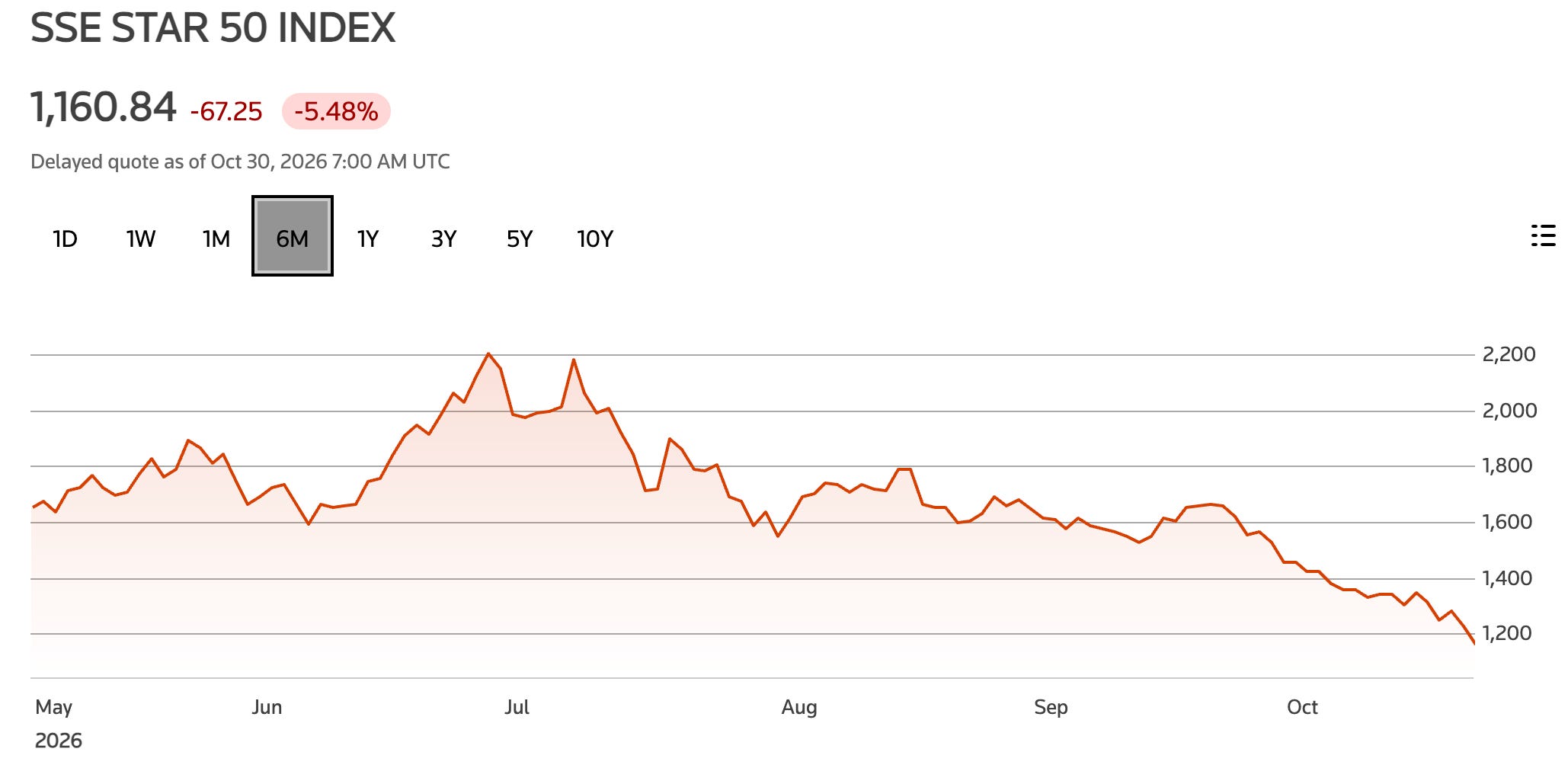
Other indices plummeted as well:
ChiNext: -39%
CSI 1000: -25%
Hang Seng Tech: -11%
Every Chinese segment fell. LLM developers lost 59%, followed by compute and infrastructure at 49%. Robotics fell 26%, AI software 24% and big-tech platforms 10%.
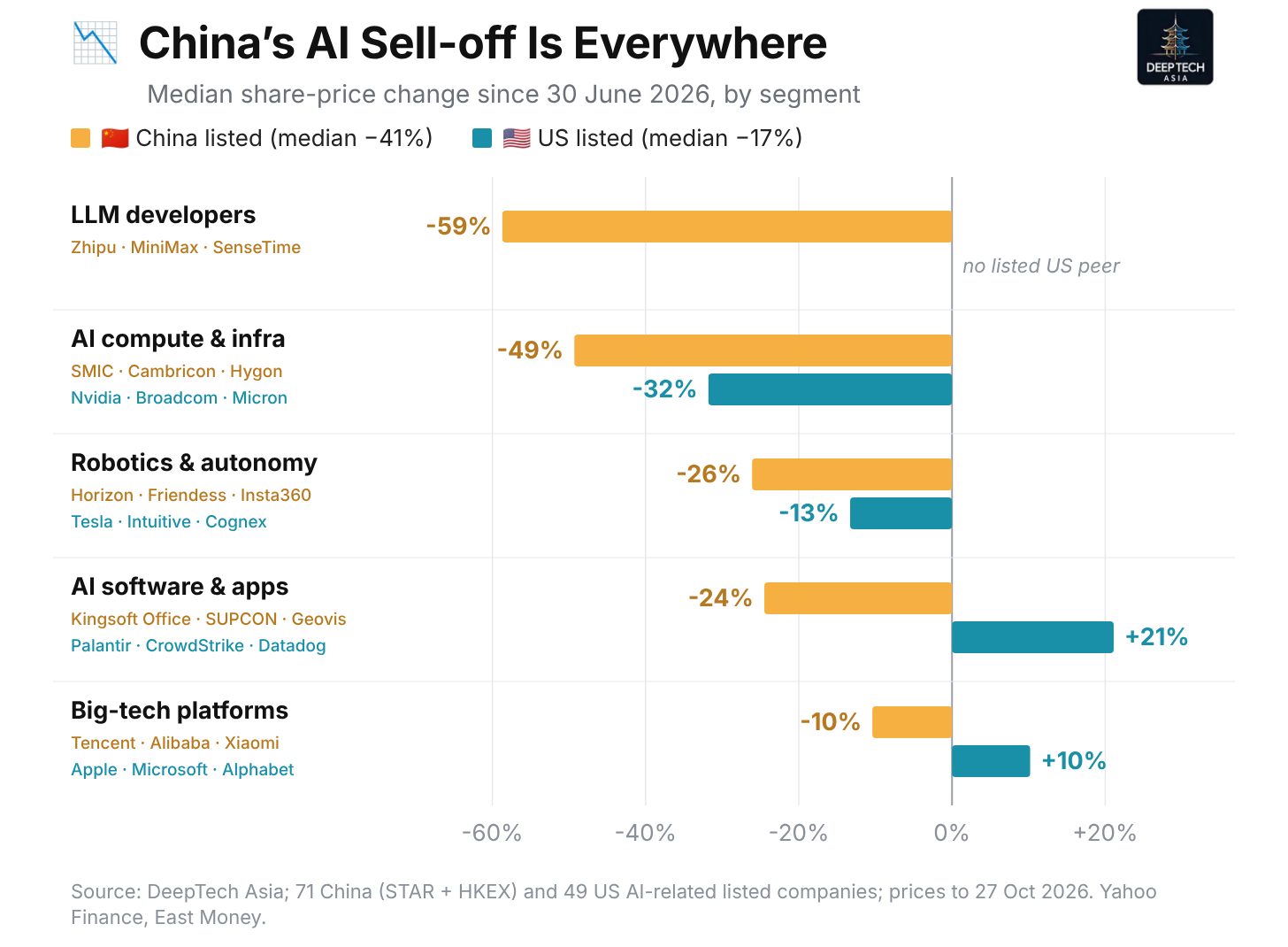
Compute sell-off happened not only in China — US AI infra stock also lost 32% since July, including Nebius (-38%), CoreWeave (-40%), GlobalFoundries (-43%).
Meanwhile, many US AI software and big-tech stocks still continued to rise. Which is why neither S&P 500, nor Nasdaq felt the same pressure as STAR Index or Hang Seng.
Valuation correction is the key driver for China’s AI sell-off.
Historically, Chinese stock is traded at discounts compared to the US — the so called “China discount”.
But this year, public stock in some Chinese sectors enjoyed extremely high multiples, in particular, LLMs and semiconductors:
LLMs: Minimax (>200x P/S), Zhipu (>1000x P/S) vs Anthropic (~20x), OpenAI (~25x).
Semiconductors: MetaX (>170x), Illuvatar (>170x), Cambricon (~120x) vs Cerebras (~90x), AMD (~25x), NVIDIA (~20x).
I view the current AI sell-off in China as a healthy correction to fair prices.
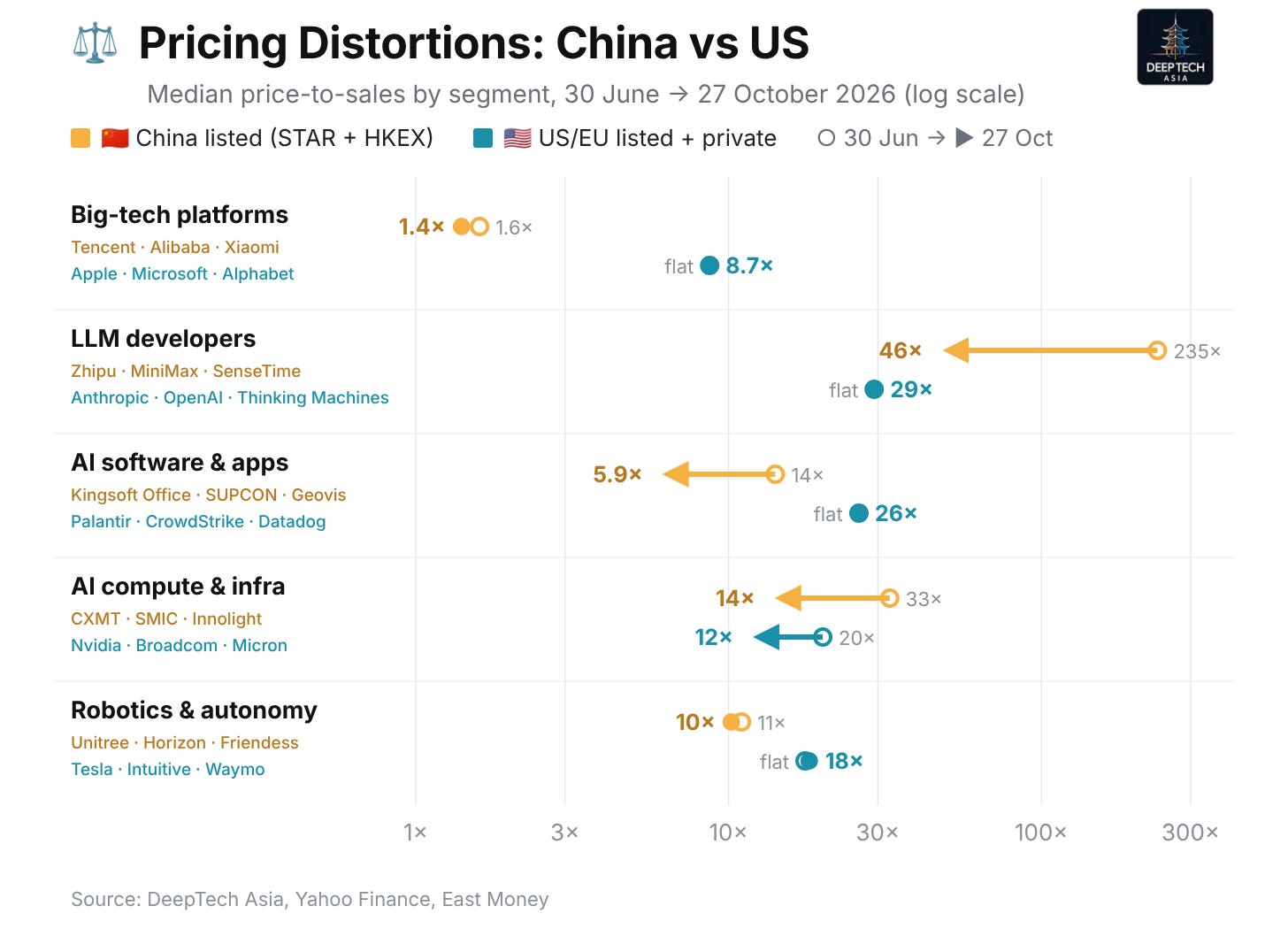
As of now, most Chinese comparables in those two areas still haven’t reached the levels of their US peers, which is why this decline may continue.
At the same time, while median P/E multiples across Chinese AI stock dropped significantly in Q3 2026, the median earnings continued growing.
This sell-off is driven by multiples correction, rather than worsening fundamentals.
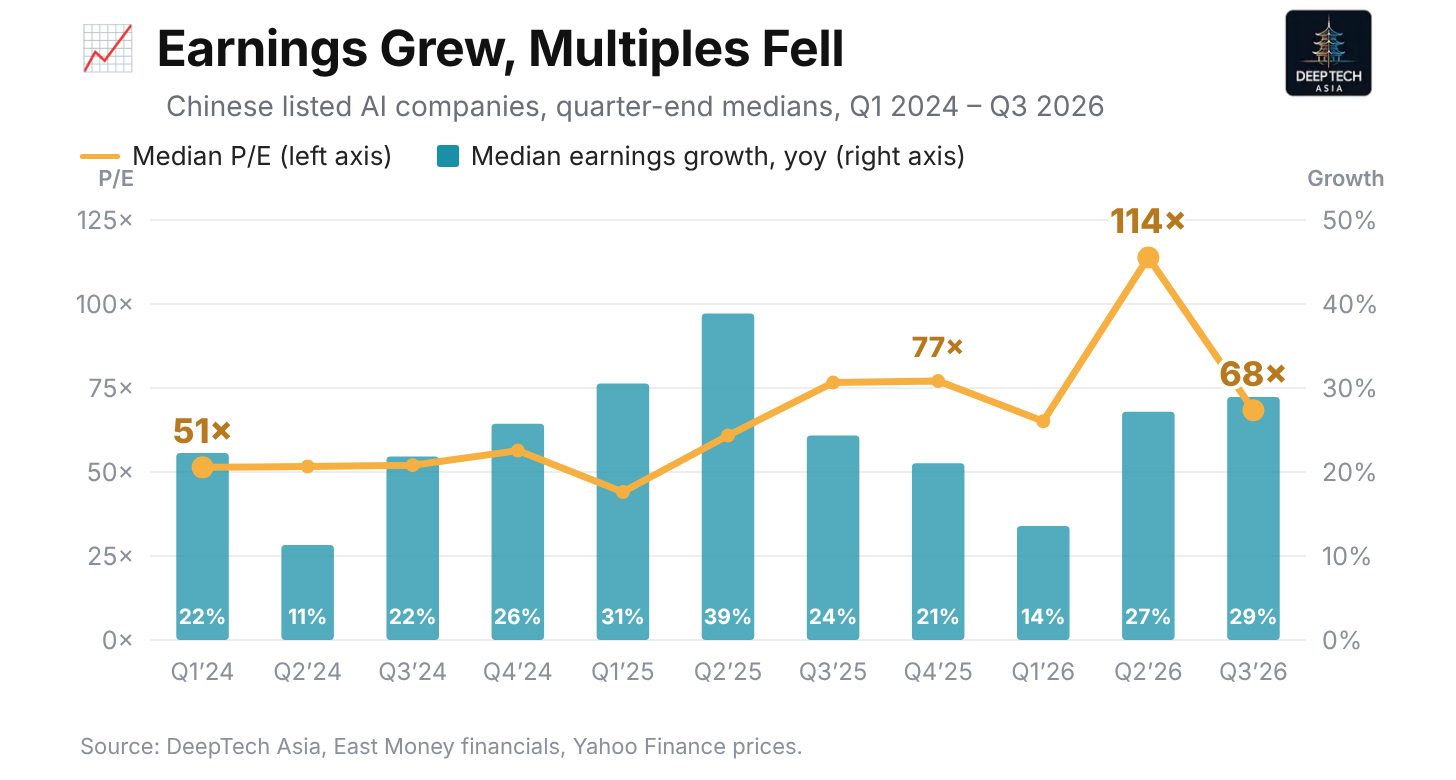
However, I expect that these Chinese companies might eventually trade even below their US peers due to “China discount”.
“China discount”
Some investors argue that Chinese stocks with strong fundamentals are undervalued because of the “China discount.” Their bet is that this discount will eventually narrow — or disappear — allowing companies such as Alibaba and Tencent to trade at multiples closer to those of US peers such as Amazon and Meta.
I don’t believe “China discount” will disappear in the near future.
And this is not related to geopolitics or general investor scepticism about China.
There are two fundamental reasons why “China discount” still applies to almost every Chinese company these days:
High competition — price wars are driving margins down.
Weak consumer demand — caps revenue growth and upside potential.
Both factors are hard to change in the short or mid term.
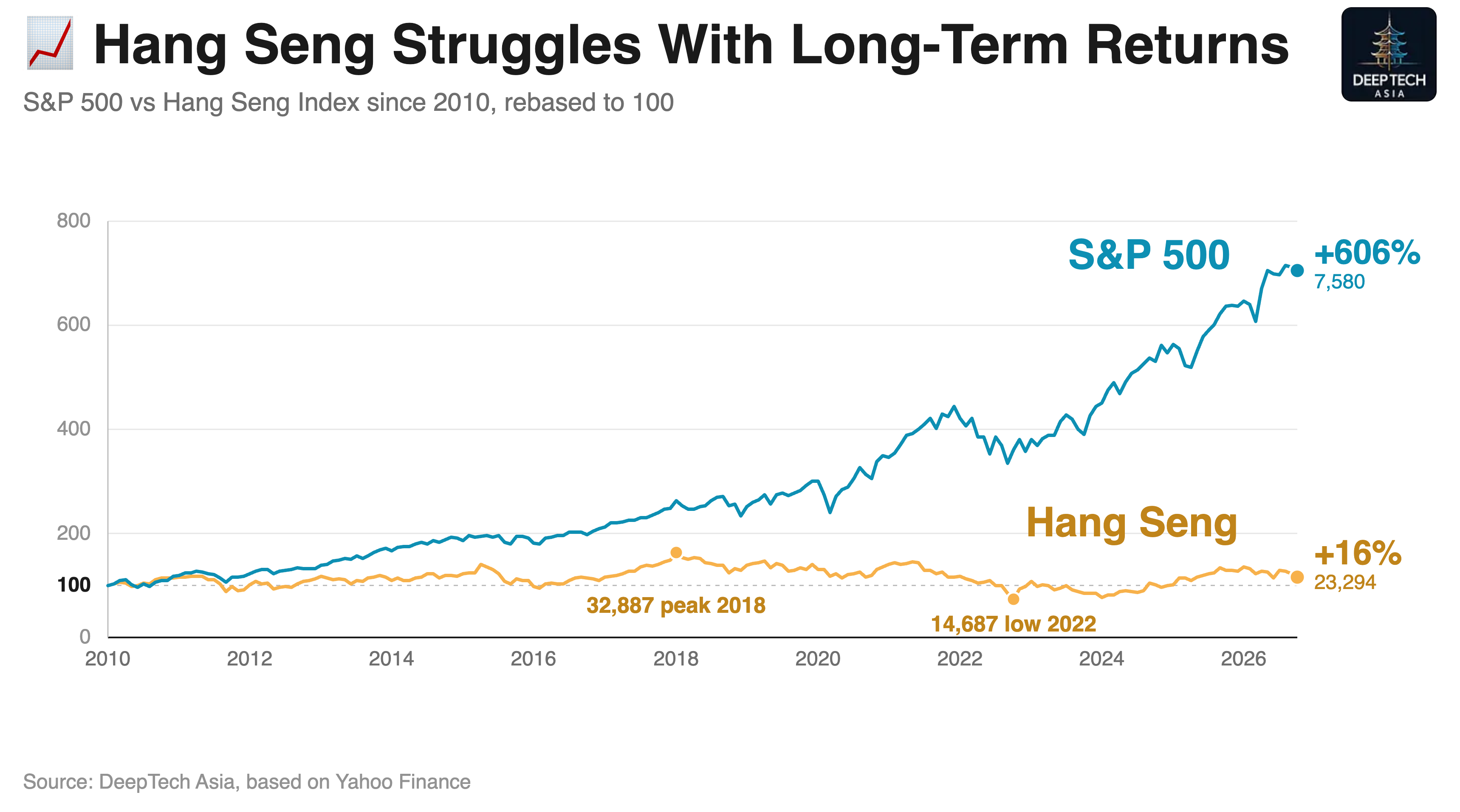
China’s stock indices are another representation of “China discount”. The Hang Seng can rally sharply in the short term, driven by stimulus, Southbound inflows or geopolitical thaws, but over the long term it still underperforms S&P 500 and Nasdaq.
The same goes for many China’s global champions — they managed to wipe out international competitors and capture a significant market share globally, but it doesn’t mean they delivered satisfactory long-term returns for investors.
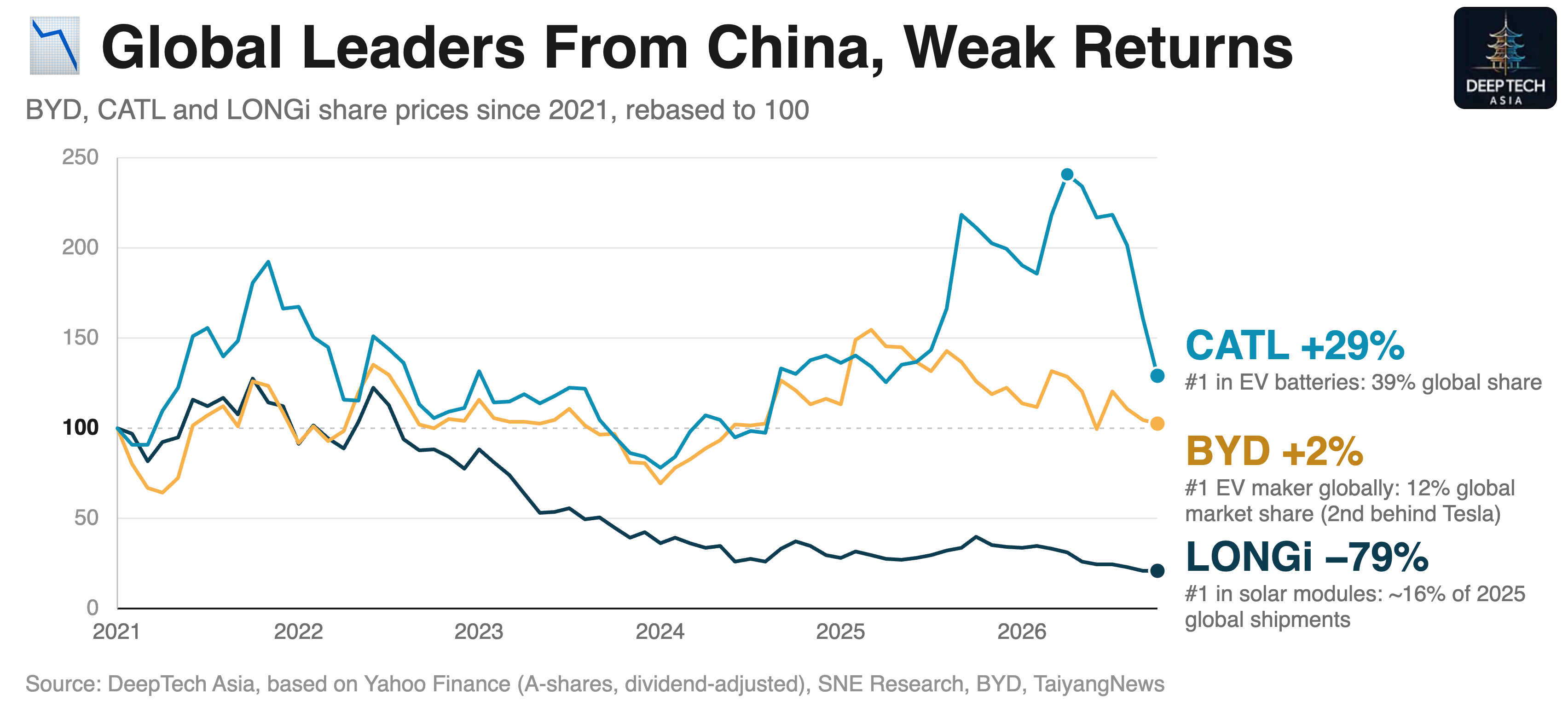
I believe, until the fundamental problems with 1) high competition, and 2) weak consumer demand are solved, Chinese public stock will struggle in the long-term.
Private / Public Arbitrage in China
At the same time, investors can leverage the arbitrage between valuations on the private and public markets in China.
Right now, this opportunity exists broadly across AI-related compute space: memory chips, foundries, AI chip design.
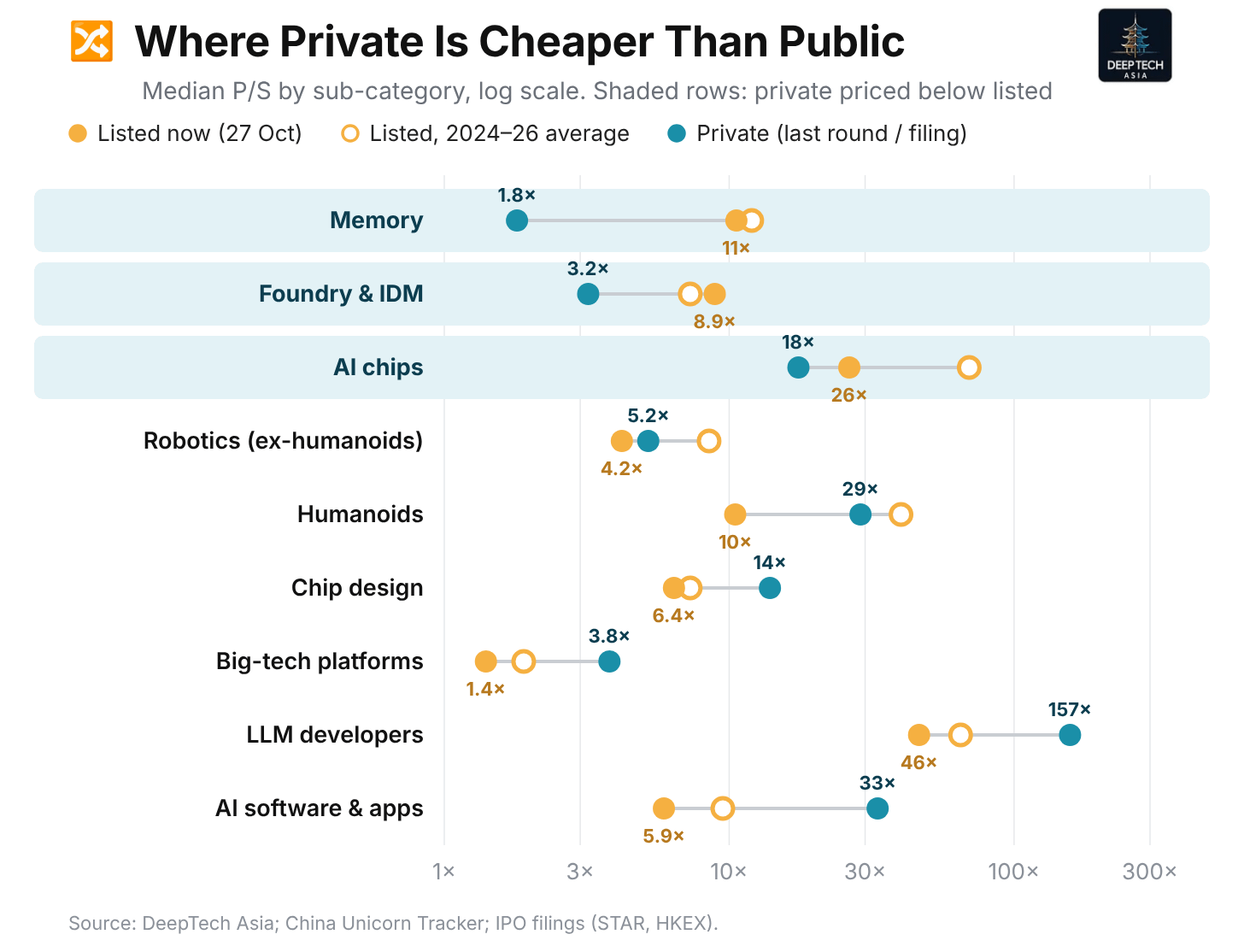
Memory:
Private: YMTC 长江存储 (2.5× P/S), Hosin Global 宏芯宇 (1.0× P/S).
Public: CXMT 长鑫科技 (14.6× P/S), Giantec 聚辰股份 (12.9× P/S), GigaDevice 兆易创新 (11.4× P/S).
Foundry & IDM:
Private: Goertek Micro 歌尔微电子 (3.2× P/S), XMC 武汉新芯 (2.0× P/S).
Public: SJ Semiconductor 盛合晶微 (23.8× P/S), Hua Hong 华虹公司 (15.3× P/S), SMIC 中芯国际 (11.6× P/S).
AI chips:
Private: T-Head 平头哥 (29.0× P/S), Kunlunxin 昆仑芯 (6.0× P/S).
Public: Cambricon 寒武纪 (50.3× P/S), Iluvatar CoreX 天数智芯 (29.6× P/S), MetaX 沐曦股份 (91.8× P/S), Moore Threads 摩尔线程 (66.7× P/S).
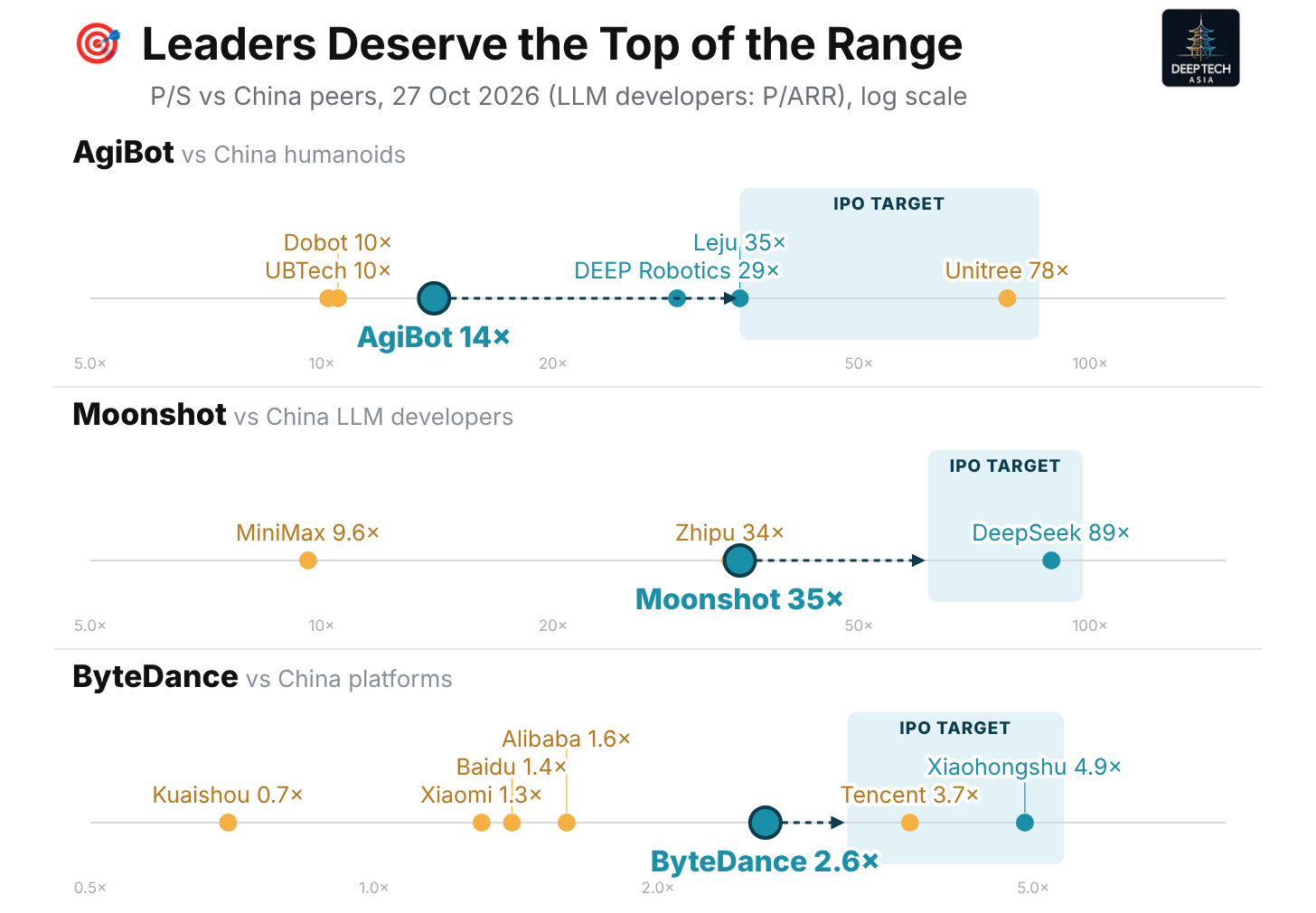
This arbitrage can be leveraged by category leaders in other industries too:
Bytedance (big tech) may have multiples closer to Tencent rather than Alibaba and Baidu because of its revenue growth (~30% YoY vs ~4% for Alibaba) and higher share of international revenue (~30% vs ~10%).
Moonshot AI (LLM) is already valued at a similar multiple as Zhipu, but can reach higher post-IPO multiples due to its stronger LLM (e.g. K3 vs GLM-5.2).
Agibot (humanoids) is enjoying higher multiples than legacy players like UBTECH or Dobot, but it is still undervalued compared to the humanoid champion Unitree.
If you have any proposals, ideas, or feedback, we’d love to hear from you! Feel free to reach out at denis@deeptech.asia or on LinkedIn. Let’s connect and explore how to improve together.